
Going Conditions Explained — How Ground Affects UK Horse Racing
Best Horse Racing Betting Sites – Bet on Horse Racing in 2026
Loading...
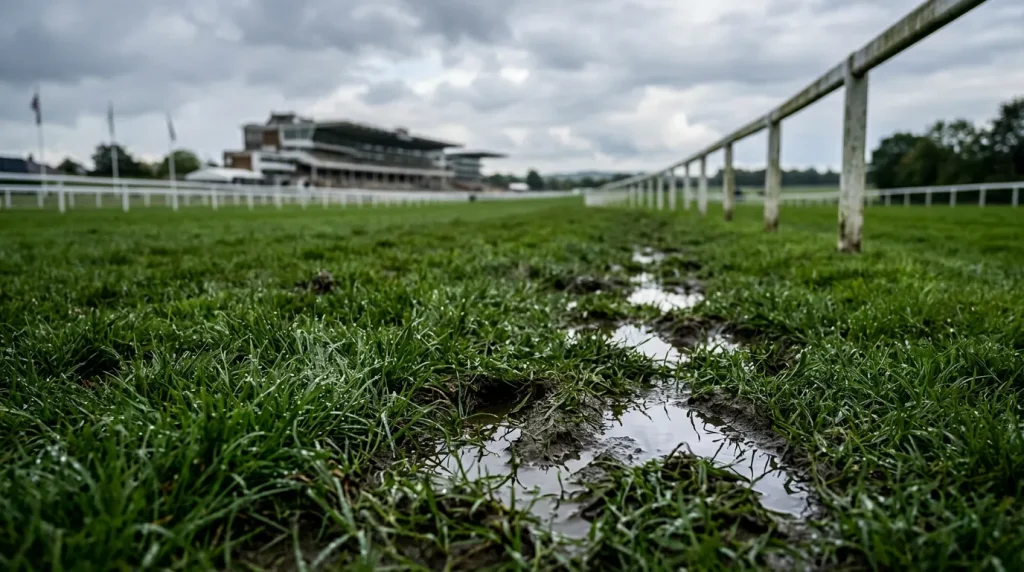
Going conditions are the one variable in horse racing that refuses to sit still. You can study a horse’s form from last month, pull up its trainer’s strike rate from the past three seasons, and examine its official rating at your leisure — all of that information is settled history. The going, by contrast, is alive. It changes overnight with a downpour, shifts between the morning inspection and the first race, and varies from one part of the track to another. It is the ground beneath the hooves, and it changes everything.
That makes going a uniquely powerful factor in race analysis. It is also, paradoxically, the factor most often reduced to a throwaway line: “check the going before you bet.” That advice is correct but useless without understanding what the going actually does — to the horse’s body, to the race dynamics, and to the betting market. An analysis of 6,268 UK races by BetTurtle found that between 71% and 85% of all races from 2016 to 2026 were run on some description of “Good” ground — Good to Firm, Good, or Good to Soft. That means the majority of form data you encounter was generated on a relatively narrow band of conditions. When the going moves outside that band — into genuinely soft or heavy ground — the predictive value of recent form can shift dramatically.
This guide goes deeper than a checklist. We start with the official going scale and how it is measured, move through the science of what different surfaces do to equine biomechanics, examine win-rate data across the full spectrum of conditions, and finish with a practical framework for weaving going into your daily selections. If you have ever wondered why a horse that looked unbeatable last time out suddenly finished in the ruck, or why a 20/1 outsider stormed home on a rain-soaked afternoon, the answer is almost always somewhere in the ground beneath the hooves.
The Official Going Scale — From Hard to Heavy
The British Horseracing Authority uses two going scales — one for Flat racing and one for National Hunt — though they overlap substantially. Both run from the fastest surface to the slowest, and the official description is determined before racing by the clerk of the course, the individual responsible for track preparation and safety.
On the Flat, the scale runs: Hard, Firm, Good to Firm, Good, Good to Soft, Soft, Heavy. National Hunt adds “Yielding” between Good and Good to Soft at some tracks, though this terminology is more common in Ireland. In practice, “Hard” is almost never declared in the UK — it implies dangerously dry ground — and “Heavy” is reserved for genuinely waterlogged conditions, most often seen in the depths of winter. The vast majority of racing takes place somewhere between Good to Firm and Soft.
Since 2007, UK racecourses have used the GoingStick — a device that measures the penetration resistance and shear strength of the turf by pushing a probe into the ground and recording the force required. The GoingStick produces a numeric reading, typically between 2.0 (heavy) and 14.0 (firm). Readings are taken at multiple points around the track, and the average becomes the official going. A GoingStick reading of 7.0 generally corresponds to “Good.” Below 5.0, you are into Soft territory. Above 10.0, the ground is drying out towards Firm.
The clerk of the course also makes a qualitative judgement, and this is where things get interesting. The GoingStick reading might suggest Good to Soft, but if there is rain forecast during the afternoon, the clerk may decide to describe the going as Soft, anticipating deterioration. Equally, strong sunshine between the morning reading and the first race can push conditions faster than the official description suggests. Experienced punters check not only the declared going but the weather forecast for the next few hours — and the clerk’s track record for accuracy at that particular course.
Rail movements are a related factor. When the inside rail has been used heavily, the ground closest to it becomes chewed up and slower, even if the rest of the track is in good condition. Clerks respond by moving the running rail out — sometimes by several metres — to bring fresh ground into play. This effectively changes the course configuration, altering distances and the quality of the surface. A horse drawn low at a track where the rail has been moved out may find itself running on the worst ground, while those drawn wider hit the better surface. The going description alone does not capture this. You need to look at whether rail movements have been announced and what they mean for the stall draws in each race.
The Science — What Happens to a Horse on Different Ground
For years, the relationship between going and performance was understood intuitively — trainers knew that certain horses “handled the mud” while others needed fast ground — but the biomechanical reasons remained vague. That changed in 2026, when researchers at the University of Central Lancashire and Nottingham Trent University published a study that quantified the relationship between turf conditions and racehorse performance with unprecedented precision.
The research team measured a property called “cushioning” — essentially, how much the ground gives way under impact, expressed in kilonewtons (kN). Their central finding was that horse speed increases as the ground becomes firmer, but only up to a point. At a cushioning level of approximately 10 kN — roughly equivalent to twice the horse’s own body weight — speed reaches a plateau. Beyond that threshold, further firmness does not make horses faster. Below it, on softer ground, speed drops and the variation between individual horses widens significantly.
Professor Sarah Jane Hobbs of the University of Central Lancashire, who led the research, described it as a study that “takes our work a step further in understanding the impact of turf going on racing performance.” The practical implication for bettors is significant. On firm or good to firm ground, the playing field is relatively level — most horses can operate near their peak speed, and the fastest horse on paper tends to be the fastest horse on the day. On soft or heavy ground, physical attributes become a differentiator. Horses with a powerful, rangy stride cope better with the extra resistance. Lighter, speed-focused animals struggle to maintain their action in holding ground, and their form figures deteriorate accordingly.
Racing analyst Simon Rowlands, commenting on the NTU research, noted that it represented “the first time that quantitative analysis of properly contextualised race times has appeared in an academic paper as an independent means for validating the nature of the racing surface.” That is an important statement. Before this work, going descriptions were based on subjective assessment and a single-device reading. Now there is a scientific framework that connects surface properties to measurable outcomes.
This matters for form reading in a direct way. If you see a horse whose speed figures dropped sharply on soft ground, you are not looking at a horse that simply “had a bad day.” You are looking at a horse whose biomechanics are poorly suited to that surface. The reverse also holds: a horse whose form reads 0058-1 may have won that last race not because it suddenly improved, but because the ground changed from good to soft and its powerful action found the conditions it was built for. The ground beneath the hooves does not just affect the result — it explains the result.
Win Rates by Going — What the Data Shows
One of the most common assumptions in racing is that going conditions dramatically change which horses win. The data tells a more nuanced story. BetTurtle’s analysis of UK races between 2016 and 2026 produced a finding that surprises many bettors: favourites win between 36% and 38% of races regardless of going conditions. Whether the ground is firm, good, or heavy, the market favourite delivers at roughly the same rate.
That stability requires explanation. It does not mean that going is irrelevant — it means that the betting market is efficient enough to adjust prices based on going preferences. When the ground turns soft, horses known to handle it attract money, and their odds shorten. Horses with poor soft-ground records drift in the market. The favourite’s win rate stays constant because the identity of the favourite changes. On good ground, the favourite might be the form horse with the best speed figures. On heavy ground, the favourite might be a stamina-laden mudlark whose recent form looks moderate but whose going record is impeccable.
Where going does create an edge is in the margins — the second and third favourites, the each-way runners, the horses that are mispriced because the market has not fully absorbed the going change. Second favourites win approximately 20% to 21% of races across all conditions, and third favourites around 14%. Those numbers, combined with average winning odds of 5.5 to 6.0 (roughly 9/2 to 5/1), suggest that the value lies not in identifying which going produces more winners, but in identifying which horses the market has underestimated given the going.
A worked example makes this concrete. Suppose a ten-runner handicap is declared on heavy ground, and the market favourite is a horse with three wins on soft but no experience of heavy. Its odds are 3/1. Meanwhile, a horse further down the card has won twice on heavy and is priced at 12/1 because its recent form on good ground was poor. The market has done a partial adjustment — it has acknowledged that soft-ground form matters — but may not have fully priced in the difference between soft and heavy. That gap between “partially adjusted” and “fully adjusted” is where going-savvy bettors find value.
The data also reveals something about field dynamics. On heavy ground, races tend to produce more spread-out finishes — the NTU research explains why, since softer ground increases speed variation between horses. This means that place bets and each-way wagers can behave differently on extreme going. A horse that would finish a close fifth on good ground might finish a distant fifth on heavy, beaten fifteen lengths rather than three. The place is the same, but the margin tells you the horse was never in contention. Conversely, a horse suited to heavy ground may run to a position that understates its effort — beaten two lengths into fourth, having made up ground through the final furlong while others laboured.
Reading a Horse’s Going Preference in the Form Guide
Identifying a horse’s going preference sounds straightforward — just look at which conditions it has won on. In practice, it is one of the trickiest parts of form analysis, because most horses have a limited number of runs on any particular ground, and the sample sizes are small enough that a single outlier can distort the picture.
Start with the obvious indicators. Most racecard providers include a going shorthand next to each horse’s name: G, GF, GS, S, HY. These letters tell you the conditions under which the horse has recorded its best results. A horse marked “GS, S” has its best form on good to soft and soft ground. One marked “GF, G” prefers drier conditions. This is the first filter, and it takes seconds to apply.
The deeper analysis involves looking not just at where the horse has won, but how it has run on different surfaces. A horse with form figures of 1-321 might look solid across the board, but if those figures break down as: win on soft, third on good to firm, second on soft, first on heavy — the pattern is clear. Its best performances correlate with cut in the ground. A horse with form of 1-108 where the win was on good to firm, the “1” was on firm, and the “0” and “8” were on soft and heavy, has the opposite profile.
Be wary of the phrase “acts on any ground.” It appears in trainer quotes and race previews, and it is sometimes true — there are horses that genuinely perform consistently regardless of surface. But more often, it means one of two things: the horse has not been tested across a wide enough range of conditions to reveal a preference, or its connections are putting a brave face on an upcoming going challenge. A horse that has won on good and good to soft has not proven it handles heavy. Declaring that it “acts on any” is an assumption dressed up as a fact.
Breeding can offer a secondary clue when the form record is too thin to draw conclusions. Sires pass on physical attributes that influence going preference. Certain stallions are known to produce offspring that relish soft ground — deep-chested, powerful types that sustain their action through resistance. Others produce speedier, lighter-framed horses that need a sound surface to show their best. This is not infallible — there are exceptions in every sire’s progeny — but when a lightly raced horse by a known soft-ground sire is declared on heavy for the first time, it is a data point worth noting.
Finally, pay attention to the time of year. A horse that ran on “good to soft” in March may have encountered a completely different surface quality from one that ran on “good to soft” in July. Spring good-to-soft often means drying ground with some residual moisture. Summer good-to-soft usually means the ground has been watered artificially and the subsurface is still firm. The label is the same; the reality is not. The ground beneath the hooves has a context, and that context is the calendar.
Seasonal Going Trends Across the UK Calendar
The UK’s climate creates a predictable — though not guaranteed — rhythm of going conditions across the racing year, and understanding that rhythm gives you a structural advantage before you even open a racecard.
Winter, roughly December through February, is dominated by National Hunt racing on turf. The BetTurtle dataset shows that in Q1, approximately 58% of races take place on soft or heavy ground. This is the season of stamina tests, where mud-loving stayers and bold-jumping types earn their keep. Form from the previous spring is often unreliable as a guide, because the going has changed category entirely. A horse that won on good ground at Aintree in April may be a different animal when presented with heavy ground at Haydock in January. The all-weather tracks — Kempton, Wolverhampton, Lingfield, Chelmsford, Newcastle, Southwell — provide an alternative during winter, offering consistent surface conditions that are unaffected by weather. They run year-round, but their role becomes more prominent when turf racing is limited.
Spring brings the season’s defining shift. From March through May, the ground begins drying out, but residual winter moisture keeps conditions on the soft side of good at most tracks. This is festival season — Cheltenham in March, Aintree in April — and the going at both venues has historically trended soft to good to soft. The Flat season begins in earnest in April, and early-season Flat racing often takes place on ground that still has some give in it. Horses returning from their winter break may encounter softer conditions than they will face later in the year, which can produce misleading first-run form.
Summer, June through August, is peak Flat season and the driest quarter. BetTurtle’s data shows just 13% of Q3 races on soft ground — the lowest of any quarter. Royal Ascot in June, Glorious Goodwood and York’s Ebor meeting in late July and August all typically feature good to firm or good ground. Watering becomes a management tool: clerks of the course water the track to keep it from going firm, but their success varies. Large fields, fast ground and high-quality racing make this the quarter where speed figures are most comparable and form is most reliable.
Autumn — September through November — is the transition. The Flat season runs through to Champions Day in October, often on softening ground. National Hunt racing returns from its summer hiatus, and the early jumps meetings take place on whatever the autumn weather provides. October and November going can be wildly variable: a dry autumn keeps conditions good or even good to firm for hurdle races at Cheltenham’s October meeting, while a wet spell can push things to soft within days. For bettors, autumn is a season where going-awareness pays the highest dividend, because the range of possible conditions on any given day is wider than at any other time of year.
The seasonal going data translates directly into betting approach. In winter, prioritise horses with proven soft or heavy form and discount recent good-ground speed figures. In summer, lean on speed ratings and trust form from similar conditions. In the transition seasons — spring and autumn — treat going as the first item on your analytical checklist, because it is the variable most likely to invalidate everything else you think you know about a race.
How to Factor Going Into Your Bets
Knowing what going does and how it varies across the year is only useful if you convert that knowledge into a repeatable process. Here is a practical framework for building going analysis into your daily routine.
Check the going first, not last. Before you study form, before you look at prices, find out what the going is at today’s track. Many punters do this backwards — they identify a horse they like, then check the going to see if it is a problem. By that point, confirmation bias has set in. You want the going to be your starting filter, not your final sanity check. If today’s going is heavy at Chepstow, you are looking for a specific type of horse. Any selection process that ignores that starting point is incomplete.
Cross-reference with the horse’s going record. Once you know the conditions, match them against each horse’s form on that surface. Look beyond win-only records — a horse that has finished second or third on heavy ground multiple times may be a better prospect than one that has a single heavy-ground win followed by three heavy-ground pull-ups. Consistency on a surface matters more than a single headline result.
Check for going changes since declaration. The going can shift between the time a race is declared and the time it is run. If rain was not forecast when trainers declared their runners but has since arrived, the going may have eased. Some horses in the field may now be on an unsuitable surface — and their connections might not have a non-runner option if the race is that afternoon. The market will begin to adjust, but early-morning prices may not have caught up. This is a window for bettors who are paying attention.
Adjust your staking, not just your selections. Extreme going conditions — heavy ground in particular — increase the variance of results. The NTU research confirms this: softer surfaces produce wider speed distributions, which means more unpredictable outcomes. On heavy ground, consider reducing your stakes or focusing on each-way positions rather than win-only bets. The same analytical edge that helps you find the right horse may not fully compensate for the increased randomness that soft ground introduces.
Track the going through the card. At most UK meetings, the going is described for the course at the start of the day, but conditions can change race by race. A track that starts as good to soft may become soft by the sixth race if the weather deteriorates or if the ground has been cut up by earlier runners. Some tracks publish updated going descriptions between races; others do not. If you are betting on later races, treat the morning going as a starting point, not a fixed reality.
The ground beneath the hooves is not a footnote in your analysis. It is the foundation. Every other piece of form data — speed figures, official ratings, trainer records — was generated on a specific surface, and that surface may or may not resemble the one in front of you today. Get the going right, and the rest of your analysis stands on solid ground. Ignore it, and you are building on sand — or mud, as the case may be.
Going conditions are not a detail to be checked and dismissed. They are a dynamic variable that shapes race outcomes, distorts form, and creates value for bettors who treat them seriously. Now that you understand the scale, the science and the seasonal patterns, you have one of the sharpest edges available to any UK racing punter. Use it every time you open a racecard — the ground beneath the hooves will reward you.