
UK Horse Racing Tips: Form, Strategy and Expert Analysis
 Available in US
No picks. No hype. Just math.
UK horse racing tips are not lottery numbers. They are the output of a disciplined process — one that weighs recent form, going conditions, trainer and jockey statistics, and the gap between a bookmaker's price and a horse's actual chance of winning. In an era where every punter with a phone can access the same racecards, the edge belongs to those who understand the method behind the selection, not just the selection itself. This page is not a list of picks for the 3:15 at Kempton. It is a blueprint for making data-backed decisions of your own.
The scale of the industry that sits behind those decisions is staggering. British racing contributed a total of £4.1 billion to the UK economy according to the BHA's submission to Parliament, with direct revenues alone exceeding £1.47 billion annually. Raceday attendance surged to 5.031 million in 2025 — the first time the sport crossed the five-million mark since before the pandemic — with the average crowd per fixture rising 3.6% to 3,526, per the BHA 2025 Racing Report. That figure is not just a trivia point; it reflects a live, expanding audience of people who are watching, analysing, and betting on the sport every week of the year.
Yet the betting landscape itself is shifting. Overall wagering turnover has declined for three consecutive years, dropping 4.3% in 2025 alone, even as racecourse crowds grew and investment in the sport reached record levels. The paradox tells its own story: fewer casual punts, more concentrated stakes on premium fixtures. The punters who remain are more selective, more informed, and more demanding of the tips they follow. They want transparency, verifiable records, and a logical framework — not vague assurances from anonymous social-media accounts.
That is precisely what this guide delivers. Across the sections below you will learn how professional analysts build their selections from raw form data, how to distinguish a credible tipster from a self-promoting one, how to protect your bankroll through mathematically sound staking, and how to align your betting with the rhythms of the UK racing calendar. Whether you are a seasoned each-way punter or someone placing a first bet at this spring's meetings, the principles are the same. Good tips are not gifts. They are data-backed decisions you can verify, replicate, and refine.
Essential Preparation for UK Horse Racing Bets
- UK horse racing tips are built on four pillars: form analysis, going conditions, trainer-jockey stats, and course-and-distance records. Understanding the method matters more than copying the pick.
- Favourites win only about 34% of the time — a reminder that blind market-following is not a strategy. Value exists where your analysis disagrees with the bookmaker's price.
- Evaluate tipsters by ROI to level stakes: 2–5% is decent, 5–10% is strong, and anything above 10% over a large sample is exceptional and rare.
- Protect your bankroll with the 2.5% rule and fractional Kelly staking. The best tips in the world cannot survive reckless stake sizing.
- Align your betting with the racing calendar: spring festivals for ante-post value, summer Flat for larger fields, and winter jumps for form consistency.
How UK Horse Racing Tips Are Built
Every credible racing tip traces back to one or more analytical pillars. Some tipsters lean heavily on form; others specialise in going or trainer statistics. The best integrate all four. Understanding these pillars does not just help you follow tips more intelligently — it lets you audit them. When a tipster says "this horse is the value play," you should be able to trace the reasoning back to something measurable. The four pillars below are the industry's common language, and the rest of this guide builds on them.
Reading Form — The Foundation
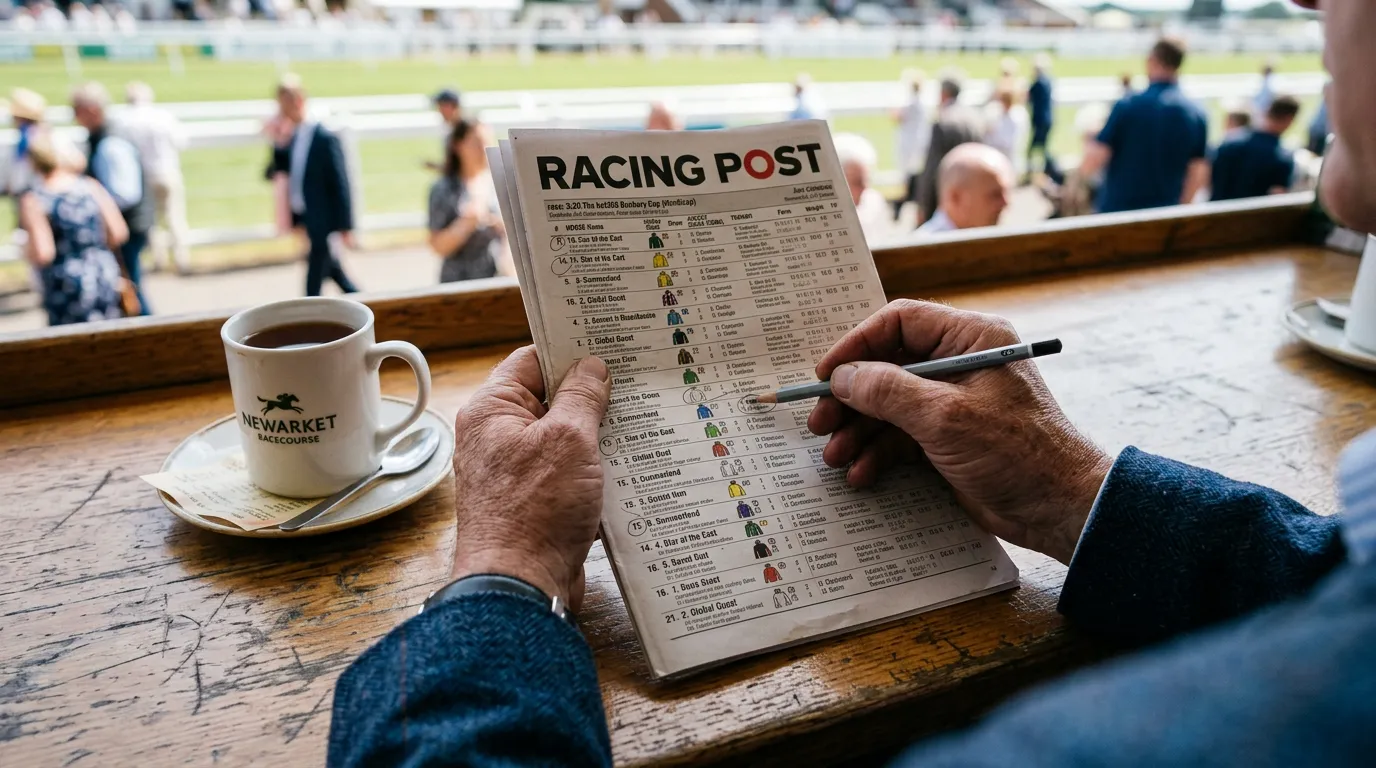
Form is the historical record of a horse's performances — finishing positions, beaten distances, class levels, and conditions. It is printed on every racecard and published online by every major racing portal, yet most casual punters glance at the last result and move on. That is a mistake. A string like 2131-4 tells a compressed story: consistent placings last season, then a below-par effort first time back, possibly on unfavourable ground or after a long absence.
The numbers do not lie, but they need context. Over the past five years, favourites in UK racing have won roughly 34.4% of all races based on Betfair Starting Price data. That means nearly two out of three favourites lose — a sobering baseline for anyone who defaults to backing the market leader without digging deeper. Meanwhile, the average field size on the Flat in 2025 stood at 8.90 runners, rising to 11.02 at Premier fixtures according to the BHA 2025 Racing Report. More runners mean more variables, which means form analysis becomes exponentially more valuable as field size increases.
At its core, reading form is about identifying patterns — improving profiles, ground preferences, class ceilings — and then asking whether the current race conditions align with the horse's strengths. It is the foundation of every data-backed decision in this sport.
Going Conditions — Ground That Changes Everything
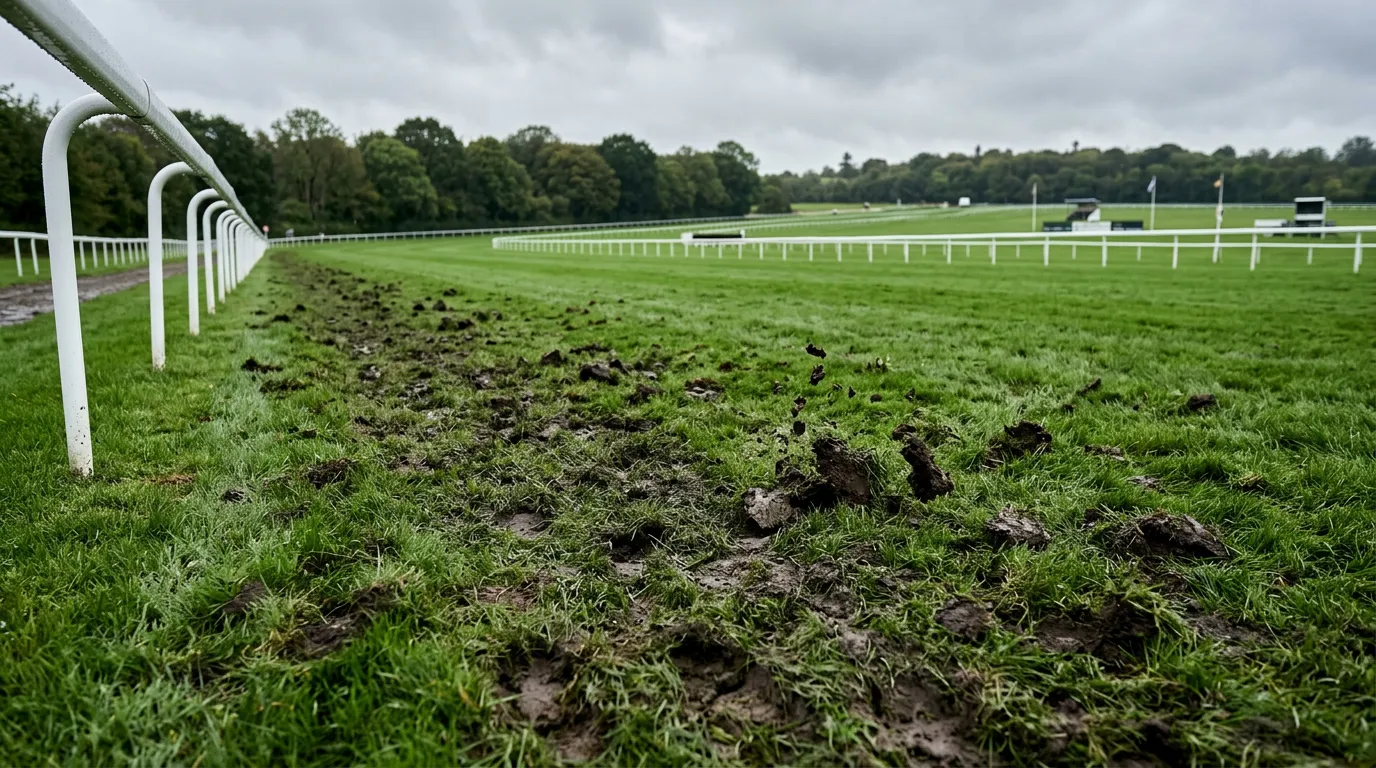
The going — the state of the racing surface — is arguably the single most underrated variable in casual betting. It ranges from Firm through Good to Heavy on turf, and Standard to Slow on all-weather surfaces. Between 2016 and 2024, roughly 71–85% of UK races were run on ground classified as Good (including Good to Firm and Good to Soft), with only 13–24% on genuinely Soft or Heavy ground, according to an analysis of 6,268 races by BetTurtle. That baseline matters because it means most form data you will read was generated on Good ground — so a horse whose best runs came on Soft is working from a smaller, potentially misleading, sample.
Research from Nottingham Trent University and the University of Central Lancashire published in 2024 quantified the relationship further. Professor Sarah Jane Hobbs of UCLan, who co-led the study, noted that it took their work a step further in understanding the impact of turf going on racing performance. The findings showed that speed on firmer surfaces peaks and then plateaus at a cushioning threshold of roughly 10 kN, while softer ground increases speed variability because horses must exert greater muscular effort. For punters, the practical takeaway is straightforward: checking the going is not optional — it is a filter that can invalidate an otherwise strong form profile.
Trainer and Jockey Records
A horse does not arrive at the start in isolation. Behind every runner sits a training operation with its own patterns — course preferences, seasonal peaks, strike rates in specific race types. Some trainers excel with two-year-old debutants; others specialise in staying chasers through the winter. Jockeys add another layer: their booking patterns, course knowledge, and relationship with particular stables all influence outcomes. The combination of trainer and jockey is often a stronger predictor than either alone. When a leading yard books its first-choice rider for a horse stepping up in class, the signal is clear — and the market usually notices, which is why the price compresses quickly. Tracking these partnerships over time reveals edges that single-race snapshots miss entirely.
Course and Distance Form
Some horses love Cheltenham's uphill finish. Others fall apart on Epsom's camber. Course and distance form — often abbreviated C&D — records how a horse has performed at a specific track over a specific trip. It is not infallible; a horse can win at a new venue. But it captures something that raw speed figures and class levels cannot: how a particular horse handles a particular geography. Newton Abbot, for instance, shows a 51.38% win rate for outright favourites over the past year according to OLBG data — one of the highest figures of any UK course. That kind of venue-specific bias is invisible in a general form line and is exactly the sort of edge that separates thoughtful punters from the crowd.
Types of Horse Racing Tips — From NAPs to Ante-Post
Not all tips are created equal, and they are not interchangeable. The format of a tip shapes the risk profile, the expected return, and the kind of analysis behind it. A NAP — a tipster's single strongest pick of the day — carries a different weight from an each-way suggestion in a 20-runner handicap. The global horse racing betting market breaks down roughly as follows: win bets account for about 36% of activity, each-way for 22%, singles for 15%, multiples for 10%, and forecast or tricast bets for the remainder, according to Business Research Insights. Knowing which type of tip suits your strategy is the first step towards using them effectively.
NAP of the Day
The term NAP derives from Napoleon — a card game in which the highest bid commits a player to winning every trick. In racing, a tipster's NAP is their most confident selection of the day. It is the bet on which they stake their reputation. Newspaper Naps Tables track these picks across a season, publishing running profit-and-loss figures at level stakes. The format forces accountability: unlike a list of ten selections where a tipster can quietly bury losses, the NAP is singular, public, and recorded. For punters following tips, the NAP is often the place to start — not because it always wins, but because it represents the tipster's clearest conviction backed by the deepest analysis. If their NAP record is poor, the rest of their card is unlikely to be better.
Each-Way Selections
An each-way bet is two bets in one: a win bet and a place bet. The place portion pays a fraction of the win odds — typically one-quarter in fields of eight or more runners, one-fifth in larger handicaps. Each-way tips tend to target horses at longer odds in competitive fields where a place finish is realistic even if winning is a stretch. The mathematics of each-way betting rewards patience: a 10/1 shot that finishes third in a 16-runner handicap still returns a profit. This makes each-way especially popular at festivals, where large fields and open races are the norm. However, backing short-priced horses each-way is almost always negative expected value — the place odds are too compressed to justify the extra stake. Effective each-way tipsters understand exactly where the sweet spot lies: typically somewhere between 8/1 and 20/1 in fields of twelve or more.
Accumulator and Multi-Bet Tips
Accumulators — accas — combine multiple selections into a single bet, with returns from one leg rolling into the next. The appeal is obvious: small stakes can generate headline-worthy payouts. The reality is less glamorous. A four-fold accumulator with four 2/1 shots carries an implied win probability of around 1.2%. That means you need to place roughly 80 such bets to expect a single winner, and the losing streaks in between can be brutal. Bookmakers love accumulators precisely because the overround compounds with each leg — the house edge grows exponentially. Responsible use of accumulator tips involves treating them as a small, entertainment-focused portion of your betting activity, not as a strategy for building a bankroll. If a tipster's primary output is accumulators with promises of enormous returns, that is a warning sign, not a selling point.
Ante-Post Tips
Ante-post betting means placing a wager weeks or months before a race, often at significantly higher odds than you would find on the day. The trade-off is risk: if your horse does not run — through injury, a change of plan, or unsuitable conditions — you lose your stake with most bookmakers. There is no non-runner, no bet protection in traditional ante-post markets. The value proposition is clearest for major festivals. Cheltenham, Aintree, and Royal Ascot attract huge volumes of late money that compress prices. A horse available at 16/1 in January might drift to 10/1 or shorten to 8/1 by race day, depending on trial performances and market sentiment. Smart ante-post punters accept the occasional dead-money loss as the price of accessing those early prices, and they diversify across several selections rather than loading up on a single prospect. The discipline lies in timing and position sizing — not in conviction alone.
Where to Find Reliable UK Horse Racing Tips
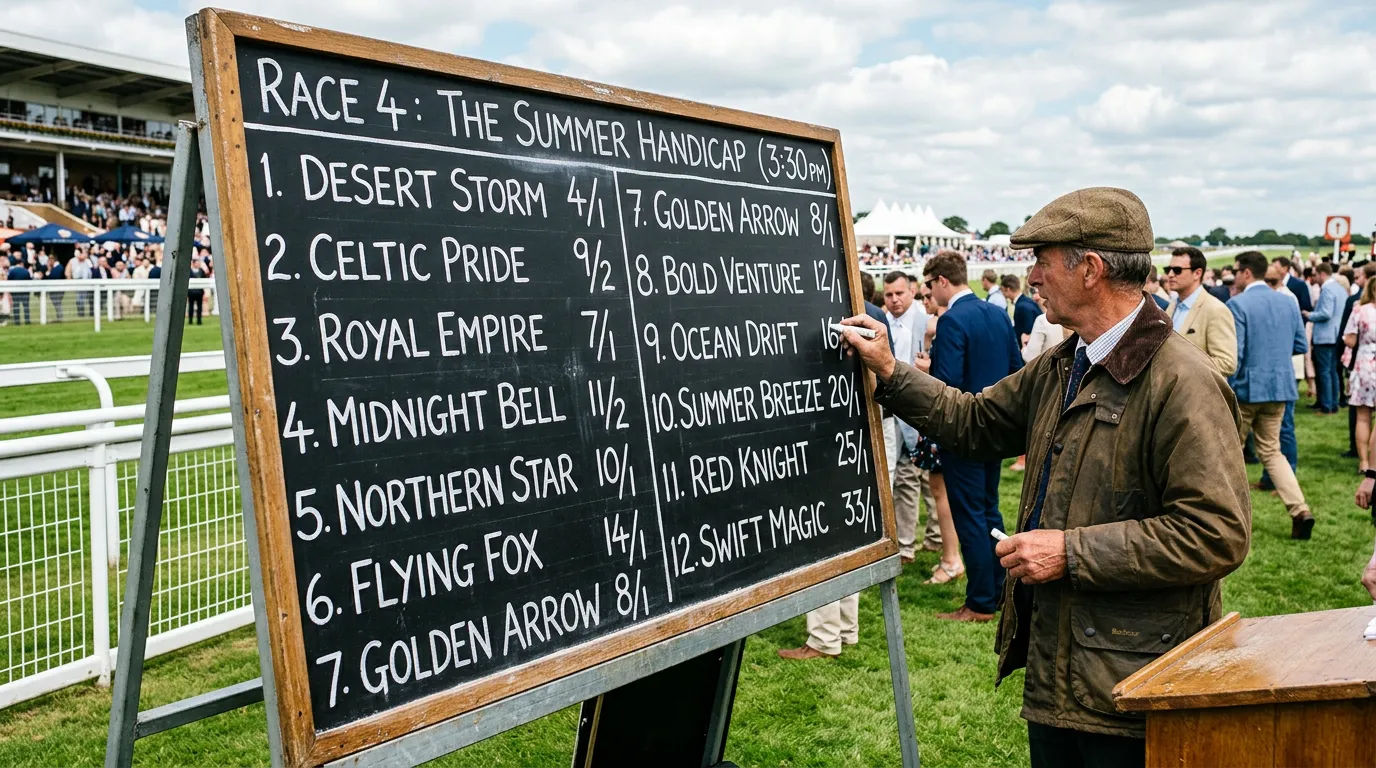
The supply of horse racing tips in the UK is enormous — and that is part of the problem. Every bookmaker blog, racing portal, newspaper column, and social media account offers selections, but the quality ranges from deeply researched analysis to algorithmically generated filler designed to drive sign-ups. The Gambling Commission's latest annual report puts the gross gambling yield from online horse racing betting at £766.7 million for the financial year ending March 2025 — a market large enough to attract every kind of operator, from legitimate analysts to outright frauds. Navigating this landscape requires knowing what each type of source actually provides, and what it quietly leaves out.
Free Tipster Platforms
Free tips come from three broad categories: media outlets, community platforms, and bookmaker-affiliated content. Media tipsters — the kind you find at Racing Post, Sporting Life, or in the daily newspapers — typically have decades of experience and publish their records in public Naps Tables. Their incentive is editorial credibility: a bad run damages their reputation, so the accountability loop, while imperfect, at least exists. Community platforms like OLBG take a different approach, crowdsourcing tips from thousands of members and ranking them by verified profit-and-loss data. The transparency is higher, but the variance is wider — top community tipsters can deliver genuine value, while the median contributor is no better than random.
Bookmaker blogs sit in a murkier space. Sites run by betting operators frequently publish tips alongside promotional content and free-bet offers. The tips themselves may be competent, but the commercial incentive is never far away: the selection process is rarely disclosed, and the long-term record is almost never published in full. That does not mean bookmaker tips are worthless, but it does mean you should apply a higher burden of proof than you would to an independent source with a publicly auditable track record.
When Paid Tips Make Sense
Paid tipping services charge a subscription fee — typically between £20 and £100 per month — in exchange for curated selections and, ideally, a more structured analytical process. The question is whether the fee pays for itself. The honest answer: sometimes. A service with a verified 5–10% ROI over a large sample of bets can comfortably justify a moderate subscription if your staking level is sufficient. If you are betting £10 per point, a 7% ROI across 500 annual tips generates £350 in profit — minus a £50 monthly subscription, you are still ahead. But if you are betting £2 per point, the maths collapses.
The critical factor is verification. Any paid service worth considering should publish its full record with an independent proofing service such as the Smart Betting Club or a similar third-party auditor. If a service refuses to submit to external verification, or publishes only selected winning months, walk away. The paid-versus-free decision is not about prestige — it is about expected value after costs. Plenty of free sources outperform paid ones over the long run.
AI and Algorithmic Predictions
Machine learning has entered the racing tips market, with several services marketing AI-generated selections based on historical data patterns. The theoretical appeal is obvious: an algorithm can process thousands of variables across tens of thousands of races without fatigue or emotional bias. In practice, the limitations are significant. Horse racing is a low-frequency, high-variance domain where key inputs — a horse's health on the day, the jockey's tactical decisions mid-race, late changes to ground conditions — are difficult to capture in structured data. Academic papers on the subject tend to show that ML models can marginally outperform naive baselines but struggle to sustain profitability after transaction costs.
That said, data-driven tools have real value as complements to human judgement. Speed-figure models, pace-scenario simulators, and statistical dashboards can surface patterns that a human analyst might miss. The danger lies in treating any algorithm as a black box that replaces analysis rather than augmenting it. If you cannot explain why the model likes a particular horse, you cannot evaluate whether the reasoning is sound — and that makes data-backed decisions impossible.
How to Judge a Tipster — Numbers, Not Promises
The racing tips market has no shortage of self-proclaimed experts. Social media timelines fill up with screenshots of winning accumulators; promotional copy promises "85% winners." But judging a tipster on cherry-picked highlights is like judging a fund manager on their single best quarter. As Richard Wayman, Director of Racing at the BHA, has noted, the horse population continues to decline and the betting environment remains challenging — a backdrop that makes genuine, sustained outperformance harder than ever and the claims of easy profit even more suspect. The only reliable method is to look at the full record through three lenses: strike rate, return on investment, and red flags.
Strike Rate in Context
Strike rate is the percentage of tips that win. It sounds straightforward, but in isolation it is deeply misleading. A tipster who backs heavy favourites at 1/3 can post a 60% strike rate and still lose money — because the wins do not return enough to cover the losses. Conversely, a tipster operating at longer odds might show a strike rate of just 12% and still be highly profitable. Consider the example of a tipster profiled by Smart Betting Club: a 12% strike rate at average odds of 10.34, producing a 29% ROI over 58 months — profitable in 39 of those months. That is an exceptional record, yet a punter fixated on strike rate alone would dismiss it on sight.
The lesson is that strike rate must always be paired with average winning odds. A 35% strike rate at average odds of 2.5 means something very different from 35% at average odds of 5.0. Without that context, strike rate is decoration, not data.
ROI to Level Stakes — The Gold Standard
Return on investment to level stakes is the single most important number in evaluating a tipster. It answers a simple question: if you had staked one unit on every tip, what percentage of your outlay would you have made back — or lost? An ROI of +5% means you gained five pence for every pound staked. An ROI of -10% means you lost ten pence per pound. The beauty of level-stakes ROI is its resistance to manipulation: it treats every tip equally, so a tipster cannot inflate their record by increasing stakes on winners after the fact.
Industry benchmarks, as outlined by BookiesEnemyNo1, place a decent ROI at 2–5%, a strong edge at 5–10%, and anything above 10% as exceptional and rare. Those numbers may seem modest compared to the wild claims you see advertised, but they reflect reality across thousands of bets. A tipster posting 7% ROI over 1,000 tips is delivering meaningful, compoundable value. A tipster claiming 40% ROI over 50 tips is operating within a sample so small that variance alone could explain the result.
Always ask for the sample size alongside the ROI. A minimum of 500 tips — and ideally 1,000 or more — over at least 12 months provides a baseline for statistical significance. Anything less is a highlight reel, not a track record.

Red Flags — Signs a Tipster Is Unreliable
Selective reporting is the most common sin. A tipster publishes their winning weeks on social media while quietly omitting the losing ones. The antidote is third-party proofing: independent services that record every tip in real time, before the race, with no ability to edit or delete. If a tipster refuses proofing, ask why.
Other warning signs include inflated profit claims that do not distinguish between level-stakes profit and variable-staking profit, since the latter can be gamed retroactively. Promises of guaranteed income are a legal and logical impossibility in a probabilistic domain. Pressure to increase stake sizes is a hallmark of services that need fresh deposits to survive. And any tipster directing you towards unlicensed betting platforms deserves immediate disqualification — traffic to unlicensed gambling sites in the UK surged by 522% in unique visitors between 2021 and 2024 according to IFHA data, a trend that exposes punters to unregulated operators with no recourse for disputes or withheld funds.
The simplest filter: a trustworthy tipster is transparent by default. Their record is public, their methodology is explained, and they acknowledge losing runs openly. Anything less is marketing dressed up as expertise.
Betting Strategy — Protecting and Growing Your Bank
You can follow the sharpest tipster in the country and still go broke. The gap between good selections and profitable betting is bridged by strategy: how much you stake, how you identify value, and how you respond to the inevitable losing runs. The broader market context makes this more important than ever. Total betting turnover on UK racing fell 6.8% in 2024 compared to 2023 according to the BHA Racing Report 2024 — and a further 4.3% in 2025, accumulating a 10.3% decline over two years per Racing Post and the BHA 2025 Racing Report. The punters still active in the market are, on average, more disciplined and harder to beat. Strategy is not optional — it is survival.
Bankroll Management Fundamentals
Your bankroll is the total amount you have set aside exclusively for betting — money you can afford to lose without affecting your daily life. The first rule is simple: define it, ring-fence it, and never top it up from other funds mid-session. Professional gamblers typically risk no more than 2.5% of their bankroll on a single bet. If your bank is £1,000, that means a maximum £25 per wager. The discipline feels constraining during a winning streak and lifesaving during a losing one.
The mathematical basis for this caution is well established. The Kelly Criterion, developed by John L. Kelly at Bell Labs in 1956, provides a formula for optimal bet sizing based on perceived edge and odds. Full Kelly maximises long-term growth but is notoriously volatile — the probability of losing half your bankroll at some point is roughly one in three. Half Kelly cuts the stake in half and reduces that ruin probability to approximately one in nine, a far more tolerable level for recreational and semi-professional punters alike. In practice, most seasoned bettors use fractional Kelly or a simple percentage-of-bank approach, adjusting only when their bankroll grows or shrinks by a meaningful margin.
Session limits complement bankroll rules. Decide in advance how many bets you will place in a day or week, and set a stop-loss: a point at which you walk away regardless of remaining opportunities. These guardrails do not guarantee profit, but they prevent the catastrophic spirals that turn a manageable losing day into a bankroll-ending one.
Finding Value — Implied Probability vs True Probability
Value is the single concept that separates long-term winners from long-term losers. A bet has value when the odds offered by the bookmaker imply a lower probability of winning than you believe the horse actually has. If a horse is priced at 4/1, the implied probability is 20%. If your analysis suggests the true probability is 28%, you have an 8-percentage-point edge — and over hundreds of bets, that edge compounds.
The formula is straightforward: Expected Value = (Probability of Win x Payout) - (Probability of Loss x Stake). A positive expected value means the bet is worth making in the long run, regardless of whether this particular horse wins today. The difficulty lies in estimating the true probability accurately — which is where form, going, trainer-jockey stats, and course data all converge.
BHA data from 2025 reveals that average turnover per race at Premier Fixtures rose 1.1%, while turnover at Core Fixtures declined 8.1%, per the BHA 2025 Racing Report. Bettors are increasingly concentrating their money on high-profile races where information is richer, fields are larger, and market inefficiencies — the raw material of value — are more likely to exist. Following this instinct is sound: data-backed decisions thrive where data is abundant.
Staking Plans Compared
A staking plan determines how much you bet on each selection. There is no universally correct answer, but there are plans with measurable properties you can match to your risk tolerance. Level stakes — the same fixed amount on every bet — is the simplest and safest option, ideal for beginners and for evaluating a tipster's record without staking noise. Percentage of bank ties each stake to a fixed share of your current bankroll, so bet sizes shrink during losing runs and grow during winning ones — a natural risk-dampener. Full Kelly sizes each bet in proportion to your estimated edge and the odds on offer; it maximises theoretical long-term growth but is extremely volatile. Half Kelly halves that stake, cutting the probability of losing half your bank from roughly one in three to one in nine — a far more practical approach for most punters. Target profit adjusts the stake so that every winner returns the same fixed amount; it works at shorter odds but becomes dangerous at longer prices because losing streaks force ever-larger bets.
Level stakes is the default for a reason: it removes emotion from the equation and makes ROI calculation clean. If you are new to structured betting, start here. As your sample size grows and your edge estimation improves, you can graduate to percentage-of-bank or fractional Kelly. Avoid target-profit plans at longer odds — they require escalating stakes after losses, which is a formula for rapid bankroll depletion.
Whatever plan you choose, log every bet. A simple spreadsheet tracking date, race, selection, odds, stake, and result becomes, over time, the most valuable analytical tool you own — revealing not just whether you are profitable, but where your edge comes from.
The UK Racing Year — A Season-by-Season Strategy
British horse racing runs year-round, but it is not a uniform sport across those twelve months. The Flat season and the National Hunt season overlap, interweave, and present fundamentally different betting landscapes. Prize money reached a record £194.7 million across 2025, a 3.5% increase on the previous year, with racecourse contributions accounting for £103.4 million of that total according to the Racecourse Association. Kevin Walsh, Racing Director at the RCA, noted that an annual increase of 3.5% represents strong ongoing investment in the sport. That investment is not evenly distributed — it clusters around the major festivals and premier fixtures — and aligning your betting strategy with the calendar's rhythm is one of the simplest ways to improve results.
The Flat Season — April to October
The turf Flat season runs from mid-April through October, with the All-Weather circuit filling the winter months at venues like Lingfield, Kempton, and Wolverhampton. Summer Flat racing on turf is characterised by faster ground, larger fields at the major meetings, and a reliance on speed and tactical positioning over stamina. The Classic programme — the 2,000 Guineas in May, the Derby and Oaks in June, the St Leger in September — anchors the calendar and generates the season's most intensely scrutinised form.
For punters, the Flat season offers two key advantages. First, the going is generally more predictable during the summer months, with the majority of races run on Good or Good to Firm ground. Second, two-year-old racing from May onwards provides opportunities to spot unexposed talent before the market catches up. The downside is that Flat fields at non-premium meetings have been shrinking — average runners per race dropped to 8.90 in 2025 — which compresses prices and reduces the frequency of genuine value plays at everyday fixtures. Focus your energy on the bigger meetings: Royal Ascot in June, Glorious Goodwood in late July, and the York Ebor Festival in August, where field sizes and market liquidity are highest.
National Hunt Season — October to April
Jump racing is a different animal. Soft and heavy ground dominate the winter months — roughly 58% of races in the first quarter of the year run on Soft or worse — and stamina matters as much as speed. The National Hunt season peaks between October and April, with hurdle and steeplechase racing producing some of the sport's most compelling narratives: horses developing over multiple seasons, progressive chasers stepping up through the grades, and the annual pilgrimage to Cheltenham in March.
The number of horses in training fell to 21,728 in 2025, a 2.3% decline from the prior year and part of a longer downward trend recorded in the BHA 2025 Racing Report. Fewer horses can mean smaller fields, which in turn means shorter-priced favourites and less volatility — useful for punters who prefer win betting, less appealing for each-way specialists. Winter National Hunt betting rewards those who follow stable form lines: horses that have been consistent through the autumn are likelier to maintain that form in the spring, while summer jumpers returning after a break carry more uncertainty.
Major Festival Quick Guide
Festivals are where the racing calendar, the betting market, and public attention converge. They are also where the most money changes hands — and where preparation yields the greatest returns.
Cheltenham Festival — Four days in March, the centrepiece of the National Hunt season. All 28 races at the 2025 Festival ranked among the top 31 most-bet-on races of the entire year according to William Hill data. With an estimated £450 million wagered across the 2026 edition, Cheltenham is the most bet-on racing festival on the planet. The sheer volume of money creates both opportunities and traps: ante-post value evaporates quickly once the week begins, but in-play markets and each-way betting in handicaps can still deliver edge to the prepared.
Aintree Grand National Festival — Three days in April, headlined by the Grand National itself. The National is the single most bet-on horse race in the world, attracting more individual wagers than even the Super Bowl for a second consecutive year according to Entain's 2025 global sportsbook data. The race's unique character — a marathon distance, large field, formidable fences — makes it a puzzle unlike any other. Historical trends around age, weight, and recent form at Cheltenham are the sharpest filters available.
Royal Ascot — Five days in June, the premier Flat festival. It drew around five million television viewers across the 2025 meeting. Quality Group racing dominates the card, with draw bias and pace analysis playing bigger roles than at most other festivals. The international dimension — runners from Ballydoyle, American raiders, French challengers — adds layers of complexity that reward deep-dive form study.
Glorious Goodwood and York Ebor — Late July and August respectively. Both offer large-field handicaps ideal for each-way punters, and they serve as the last major form tests before the autumn Flat calendar.
Punter's Glossary — 30+ Terms with Context
Racing terminology can feel like a foreign language. The definitions below are not dictionary entries — each one explains what the term means for your betting.
- Accumulator (Acca) — A single bet combining four or more selections; all must win for a return. The payout multiplies with each leg, but so does the probability of losing.
- Ante-Post — A bet placed well before race day, usually at higher odds. Typically stakes are lost if the horse does not run.
- Best Odds Guaranteed (BOG) — A bookmaker promise to pay the higher of the price you took and the starting price. Essential for early-morning bettors.
- Banker — A selection considered almost certain to win, often used as the anchor leg in multiples. No horse is truly certain.
- Bumper — A National Hunt flat race for horses without hurdle or chase experience. A starting point for future jumps stars.
- C&D (Course and Distance) — Indicates a horse has won at the same track over the same trip. A positive signal, not a guarantee.
- Chase — A steeplechase race over larger fences, typically run over longer distances than hurdles. Demands jumping accuracy and stamina.
- Draw — The stall position from which a horse starts in a Flat race. At certain courses and distances, inside or outside draws carry measurable advantages.
- Drift — When a horse's odds lengthen (become less favoured by the market). Can signal lack of confidence from informed money.
- Each-Way (EW) — Two bets in one: a win bet and a place bet. The place portion pays a fraction of the win odds depending on field size and race type.
- Expected Value (EV) — The average profit or loss you would make if you placed the same bet many times. Positive EV means long-term profit; negative EV means long-term loss.
- Favourite — The horse with the shortest odds in a race, meaning the market considers it most likely to win.
- Form — A horse's recent race record, shown as a sequence of finishing positions. The most concentrated source of information on any racecard.
- Going — The condition of the racing surface, from Firm (dry, fast) to Heavy (wet, demanding). Published before each meeting and updated if conditions change.
- Handicap — A race in which horses carry different weights based on their official ratings, designed to equalise chances. Most competitive race type for bettors.
- Hurdle — A jump race over smaller, flexible obstacles. Typically the entry point for young National Hunt horses.
- Implied Probability — The chance of winning as expressed by the bookmaker's odds. At 4/1, the implied probability is 20%.
- Kelly Criterion — A mathematical formula for calculating optimal bet size based on perceived edge and odds. Full Kelly maximises growth; fractional Kelly reduces volatility.
- Level Stakes — Betting the same amount on every selection. The standard method for measuring tipster performance because it removes staking manipulation.
- Maiden — A horse that has not yet won a race. Maiden races are restricted to horses without a prior victory.
- NAP — A tipster's strongest selection of the day. From the card game Napoleon, where the highest bid commits you to every trick.
- NB (Next Best) — A tipster's second-strongest selection after their NAP. Usually carries slightly less confidence.
- Non-Runner — A horse withdrawn from a race before the start. Stakes are returned on most day-of-race bets but not on ante-post wagers.
- Official Rating (OR) — A number assigned by the BHA handicapper reflecting a horse's assessed ability. Higher ratings indicate better horses.
- Overround — The bookmaker's built-in margin. If the implied probabilities of all runners sum to more than 100%, the excess is the overround — the house edge.
- Place Terms — The conditions determining how many positions qualify for an each-way payout and at what fraction of the odds. Varies by field size and race type.
- Price Boost — An enhanced odds offer from a bookmaker, usually on selected races. Can offer genuine value, but check the conditions.
- ROI (Return on Investment) — Total profit or loss divided by total amount staked, expressed as a percentage. The single most reliable measure of a tipster's value.
- SP (Starting Price) — The official odds of a horse at the moment the race begins, as determined by on-course bookmakers.
- Steamer — A horse whose odds shorten rapidly, often indicating significant market support. The opposite of a drift.
- Treble — A bet combining three selections; all must win. Higher variance than a single, lower than a four-fold acca.
- Value — A bet where the offered odds are higher than the true probability of the outcome. The foundation of all long-term profitable betting.
Frequently Asked Questions About UK Horse Racing Tips
What is a NAP and how is it chosen?
A NAP is a tipster's strongest selection of the day — the single pick they would stake their reputation on. The name comes from Napoleon, a card game in which the boldest bid commits a player to winning every trick. Professional tipsters choose their NAP by narrowing the day's racecards to the race where they see the greatest gap between a horse's true chance and its market price. That usually means a convergence of strong recent form, favourable going conditions, a positive trainer-jockey combination, and a course profile that suits. Naps Tables published in newspapers and on sites like Racing Post track these selections at level stakes across a full season, making the NAP the most accountable format in racing tips. If you only follow one tip per day, the NAP is the logical choice — not because it always wins, but because it carries the fullest weight of the tipster's analysis.
Are free horse racing tips reliable?
Some are, many are not — and the distinction comes down to transparency, not price. Free tips from established media tipsters with publicly tracked records in Naps Tables can match or outperform paid services over time. Community platforms that verify member results through profit-and-loss records also provide a layer of accountability that most paid services lack. The problem with free tips lies in the business model behind them: if the source generates revenue through bookmaker referrals or sign-up bonuses, the tips may be optimised for click-through rather than profitability. The key test is whether the provider publishes a full, unedited record of past selections. If the complete history is available and shows a positive ROI to level stakes over a meaningful sample — several hundred tips at minimum — the tips are worth following regardless of whether they cost money. If the record is hidden, partial, or non-existent, free or paid makes no difference: you are betting blind.
What should beginners look for when following UK horse racing tips?
Start with three things: a clear explanation, a verified record, and a manageable volume. A good tip source does not just tell you what to back — it tells you why, referencing form, going, or market conditions in a way you can follow and eventually replicate. The record should be available publicly, ideally tracked by a third-party proofing service or published daily in a Naps Table. And the volume should match your bankroll: beginners are better served following one or two well-reasoned NAPs per day than ten selections across multiple racecards. Beyond the source itself, set a fixed stake you are comfortable losing, keep a simple log of your bets, and resist the temptation to chase losses after a bad day. Horse racing betting is a long game, and the first skill to develop is patience — both with the tipster and with your own learning curve.
Responsible Betting — Tools, Limits and Support
No discussion of betting strategy is complete without acknowledging the line between entertainment and harm. Horse racing attracts a broad spectrum of participants — from once-a-year Grand National punters to daily bettors with structured bankrolls — and the data shows that the vast majority engage responsibly. According to the Gambling Commission's participation survey from the April–July 2025 wave, around 7% of UK adults had placed a bet on horse racing in the previous four weeks, with participation peaking during the spring and summer festival season. Problem gambling among racing bettors, as recorded by Health Survey for England data cited in BHA parliamentary evidence, stands at approximately 2.8% — lower than several other gambling verticals, but still a figure that represents real people facing real difficulty.
The practical tools available to UK punters are more robust than many realise. Every licensed betting operator is required to offer deposit limits, loss limits, session time reminders, cooling-off periods, and self-exclusion options. GAMSTOP, the national self-exclusion scheme, allows you to block yourself from all licensed online gambling sites for a period of six months, one year, or five years. These are not signs of weakness — they are risk management tools, no different in principle from the stop-losses discussed earlier in this guide.
If you notice that betting is causing anxiety, interfering with relationships, or leading you to chase losses beyond your pre-set limits, act early. The National Gambling Helpline, operated by GamCare, offers free and confidential support. GambleAware provides self-assessment tools and referrals to treatment services. The strength of the UK regulatory framework means that help is available, accessible, and free — but only if you choose to use it.
One broader point deserves attention. The affordability checks introduced by the Gambling Commission have been controversial within the industry, but their intent — preventing operators from profiting from at-risk customers — aligns with the interests of any punter who takes a structured approach. Responsible gambling and profitable gambling share a foundation in discipline, self-awareness, and a willingness to stop when the numbers say stop.
Your Next Move
You have the framework. Form analysis, going conditions, tipster evaluation, bankroll management, seasonal strategy — each section of this guide adds a layer to the system that separates data-backed decisions from hopeful guesses. The question now is not whether the information exists, but whether you will use it.
Start small. Pick one upcoming race meeting, apply the form-reading principles from the early sections, check the going, cross-reference with trainer-jockey records, and decide whether the bookmaker's price reflects the horse's genuine chance. Log the bet, win or lose, and review it afterwards. That single cycle — analysis, decision, record, review — is the engine of every profitable punter's career. Everything else is refinement.
