
Seasonal Horse Racing Strategy — Aligning Your Bets With the Calendar
 Available in US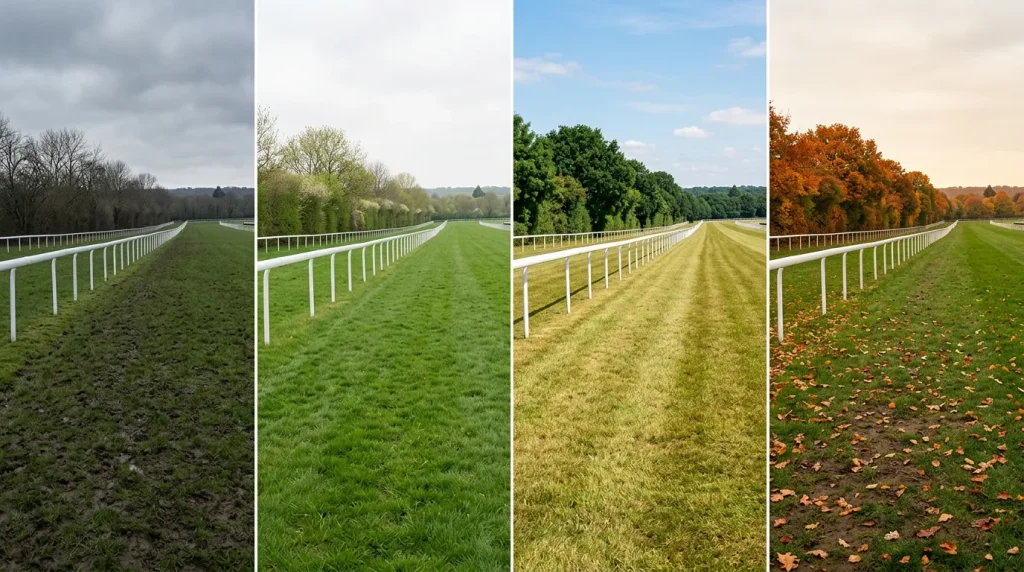
The UK racing calendar is not uniform. The going changes, the codes shift, the field sizes fluctuate and the character of the betting markets transforms across the year. A punter who bets the same way in January as they do in July is ignoring an entire dimension of information — and the calendar is your first filter. Aligning your strategy with the season is not a luxury; it is a structural necessity.
The data confirms the scale of seasonal variation. According to BetTurtle’s analysis of over 6,000 UK races, approximately 58% of winter races are run on soft or heavy going, compared with just 13% during the summer months. That single variable — the going — reshapes which horses are suited, which trainers thrive and which bet types offer value. Layer on the shifts between Flat and Jump codes, the festival calendar and the ebb and flow of public betting interest, and the case for a season-aware approach becomes overwhelming.
This article maps the year quarter by quarter: what is racing, what conditions prevail and how your betting approach should adapt accordingly.
Q1 — Winter Jumps and Soft Ground Specialists
January through March is the core of the National Hunt season. The ground is at its softest, the fields at their most competitive (for Jumps), and the entire calendar builds towards the Cheltenham Festival in the third week of March. This is the quarter for stamina specialists, mudlarks and trainers whose horses are bred to thrive in demanding conditions.
The going is the dominant factor. With 58% of races on soft or heavy ground in Q1, form achieved on quicker surfaces earlier in the season may not translate. Horses that won on Good going in November may struggle on Heavy in February. Your first filter for every Q1 selection should be whether the horse has demonstrated an ability to handle winter ground — and if the data is inconclusive, the risk is higher than in seasons where conditions are more consistent.
Casual betting participation is at its lowest during Q1 — weekday racing at Wetherby or Plumpton does not draw the public in the way that a Saturday ITV card in the summer does. The BHA’s Racing Report for 2026 showed an overall decline in betting turnover of 6.8% that year, and winter midweek cards bear a disproportionate share of that decline. Reduced public interest means less money in the market, which can produce less efficient odds — pockets of value that a more crowded summer market would eliminate.
Ante-post markets for Cheltenham dominate Q1 thinking. The trial races — Leopardstown at Christmas, Cheltenham’s own January meeting, Newbury and Kempton in February — provide the data that shapes ante-post prices. If you are an ante-post punter, Q1 is your busiest quarter: monitoring trials, updating your assessments and taking positions before the market tightens in March.
Q2 — Spring Festivals and the Flat Returns
April through June bridges the two codes. The Jump season reaches its climax at Aintree (Grand National) and Punchestown in April, then gives way to the Flat season on turf, which gathers momentum through May’s Guineas festivals and peaks at Royal Ascot in mid-June.
The going transitions rapidly in Q2. March and early April can still produce soft winter ground; by late May, the turf has dried and Good to Firm is common. This transition period creates opportunities for punters who track the going closely, because the market adjusts slowly: a horse whose form is all on soft ground may still be fancied by the public despite the going firming up, creating value elsewhere in the field.
The Flat season introduces younger, less-exposed horses — two-year-olds making their debuts and three-year-olds contesting the classics. Early-season Flat form is inherently volatile, because many runners have limited race records and their ability is still being established. This volatility cuts both ways: it creates pricing inefficiency (bookmakers have less data to work with) but also reduces the reliability of your own form analysis. The best approach in the early Flat weeks is selectivity: bet on races where you have a genuine form opinion and avoid those where the field is dominated by unraced debutants.
Royal Ascot in June marks the first major peak of the Flat betting calendar. Prize money, field sizes and market liquidity all reach their highest levels, creating the deepest, most competitive Flat betting environment of the year. If you have managed your bankroll wisely through Q1 and Q2, Ascot is the week where that discipline pays off — the sheer quality and quantity of opportunities reward preparation.
Q3 — Peak Flat Season and Big-Field Handicaps
July through September is peak Flat season. The Glorious Goodwood meeting in late July, the Ebor Festival at York in August and the St Leger meeting at Doncaster in September headline the calendar. The going is predominantly Good to Firm or Firm, field sizes are at their largest and the each-way opportunities are at their most abundant.
Big-field handicaps define Q3 betting. The Stewards’ Cup at Goodwood, the Ebor at York and the Ayr Gold Cup in September all attract fields of 20 or more runners, with place terms of four or more at quarter the odds. These are the each-way punter’s paradise: wide-open races where double-digit prices are not unusual among genuine contenders, and where the place portion alone can generate meaningful profit. Draw bias, pace analysis and trainer form at the specific course are the key selection tools in these contests.
The summer also sees the busiest period for all-weather racing on evenings and weekends, providing additional opportunities for punters who specialise in the AW surfaces. AW form is distinct from turf form, and specialists who understand the nuances of Polytrack, Tapeta and Fibresand can find value in markets that the turf-focused majority overlooks.
Public participation is at its highest in Q3. More money in the market generally means more efficient pricing — but the casual money also compresses favourites’ odds, sometimes below their true probability. If you can identify situations where the public is over-backing a fancied runner (perhaps on the basis of a big name or a recent headline win), the value often lies with the second or third choice in the market, whose price has drifted as money flows towards the crowd favourite.
Q4 — Autumn Transition and Jump Season Begins
October through December marks the transition from Flat to Jumps and sets the stage for the following year’s campaigns. The going softens as autumn rain arrives, the Flat season on turf closes with Champions Day at Ascot in mid-October, and the National Hunt programme builds in quality and intensity through November and into December.
Champions Day is the Flat season’s grand finale — a single afternoon of top-class Group 1 racing on ground that is often softer than the summer norm. Form from the summer does not always transfer to the autumn conditions, which creates opportunities for horses whose pedigree or track record suggests they improve on an easier surface. Champions Day attracts significant betting interest and can provide a profitable end to the Flat campaign if you approach it with fresh going analysis rather than relying on summer form alone.
The Jump season’s early weeks in October and November are worth approaching cautiously. Horses are returning from summer breaks, fitness levels are uncertain, and the going is transitional — neither the consistent winter soft nor the reliable summer quick. Early-season Jumps form is the least reliable of the year, and your staking should reflect that uncertainty. Smaller bets, narrower portfolios and a willingness to observe rather than act are all sensible Q4 habits.
By December, the picture sharpens. The King George VI Chase at Kempton on Boxing Day is the first championship-quality Jump race of the season, and the Leopardstown Christmas meeting provides key Cheltenham trial data from Ireland. December is when serious ante-post punters begin staking on festival targets, using Q4 results to update their assessments. This is the quarter where you gather intelligence for the profitable action that Q1 and Q2 will deliver.
