
Royal Ascot Tips — How to Bet on Flat Racing’s Premier Week
 Available in US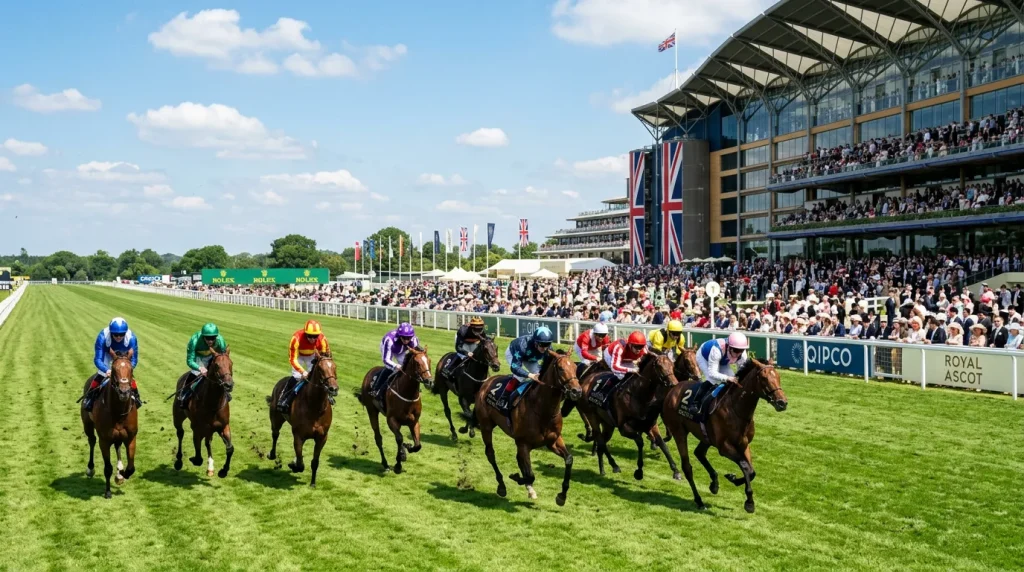
Royal Ascot is where class meets data. It is the most prestigious Flat racing festival in the world — five days in June that concentrate the highest-quality horses, the deepest international competition and the most intense betting activity of the entire Flat season. The top hats and morning suits dominate the television coverage, but beneath the pageantry lies a betting market of serious scale and serious complexity.
According to Play Wager, Royal Ascot 2026 drew approximately five million television viewers across the five days, with final-day viewership rising more than 20% compared to 2026. World Pool turnover — the international tote pool that runs alongside traditional bookmaker markets — exceeded £60 million for the week. Those figures reflect the event’s unique position: it is simultaneously a social occasion, a sporting spectacle and a betting festival, and the overlap between those three audiences creates a market environment unlike anything else in the Flat calendar.
For punters, Royal Ascot presents challenges that do not arise at an ordinary midweek meeting. The fields include runners from France, Ireland, America, Australia and beyond, making form comparisons across different racing jurisdictions necessary. The course itself — with its distinct straight and round-course configurations — introduces draw biases that vary by distance and ground conditions. And the sheer quality of competition means that small margins in form separate winners from losers. Getting it right at Royal Ascot requires more preparation than almost any other meeting, but the rewards — in terms of both payout and satisfaction — are proportionally greater.
Royal Ascot by the Numbers
Royal Ascot runs from Tuesday to Saturday in the third week of June, with seven or eight races each day — approximately 35 races across the five-day programme. The meeting features eight Group 1 contests, the highest classification in Flat racing, alongside Group 2 and Group 3 events and several of the most valuable handicaps in the calendar.
The prize money reflects the event’s stature. The total purse for Royal Ascot 2026 stood at approximately £10 million, distributed across every race on the card. Even the lower-grade handicaps carry purses that would headline many other meetings. That level of prize money draws the best horses from across Europe and beyond, which is why Royal Ascot fields are among the most competitive and internationally diverse of the year.
Attendance at the 2026 meeting was approximately 300,000 across the five days, with the Saturday crowd nearing the single-day record of 66,000 set in 2026. Those attendance figures feed directly into the on-course betting ring, where the volume of money creates a liquid, responsive market that moves efficiently — but not always instantly — in response to informed money. The exchange markets are similarly deep during Royal Ascot week, making it one of the most attractive trading environments of the Flat season.
The international dimension sets Royal Ascot apart from every other UK Flat meeting. In a typical year, runners arrive from Ireland, France, the United States, Australia, Japan and the Middle East. Cross-border form comparison is essential: a horse that won a Group 2 at Longchamp may or may not translate that form to Ascot’s different ground, different pace and different track configuration. Punters who only read British form are working with an incomplete picture.
Reading Group Race Form at Ascot
Group races at Royal Ascot are the highest-stakes betting events in UK Flat racing, and reading the form correctly requires an understanding of how class interacts with conditions at this specific venue.
Official ratings — Racing Post Ratings (RPR) or Timeform figures — provide the most objective starting point. In a typical Group 1 at Ascot, the principals will be rated in the 115-125 range (RPR), though exceptional individuals may sit higher. The question is not simply “which horse has the highest figure?” but “which horse’s figure was achieved under conditions closest to today’s race?” A rating of 120 earned on firm ground at Newmarket is not identical to a rating of 120 earned on soft ground at Longchamp. Ground, distance and track shape all mediate how a rating translates.
International form adds complexity. French-trained runners have an excellent record at Royal Ascot, particularly in races over a mile and further on ground with some cut. The key is identifying how French ratings map onto British ones — Timeform and Racing Post both publish adjusted figures for cross-border comparison, but the conversion is imperfect and leaves room for punters who study French racing to find value that the British market has not fully priced.
American and Australian raiders have a more mixed record. American turf specialists occasionally excel in sprint and mile races, particularly when the ground is quick, but their form on firm European turf is not always directly comparable to their US record on often-watered courses. Australian runners face similar translation challenges. Both categories attract disproportionate public money due to novelty, which can push their prices shorter than the form justifies — creating potential value on their European-trained rivals.
Trial form is the final piece. The Guineas meeting at Newmarket, the Irish Guineas at the Curragh and French trials at Longchamp and Chantilly all serve as dress rehearsals for Royal Ascot. Horses that arrive on the back of a strong trial performance tend to reproduce that form at the meeting, while those arriving after a disappointing trial face an uphill task to reverse it at the highest level.
Draw Bias and Pace at Ascot
Ascot’s course configuration creates draw biases that are well documented but not always well understood by casual punters. The course has two distinct tracks: a straight course used for races up to a mile, and a triangular round course used for races over a mile and beyond. The draw — the starting stall position allocated to each horse — matters far more on the straight course than on the round course, and its impact varies with the going.
On the straight course over five and six furlongs, the draw bias depends heavily on ground conditions. When the ground is on the faster side — Good to Firm or Firm — there is historically a moderate advantage to higher-numbered stalls (the far side of the track), because the ground near the stands rail tends to be more worn. When the ground is softer, the bias can reverse or neutralise entirely, as the centre and near-side strips offer better footing. In big-field sprints with twenty or more runners, the field often splits into two groups — high and low — and the pace dynamics within each group become a race within a race.
Over seven furlongs and a mile on the straight course, the draw effect diminishes slightly because the runners have more time to find their positions before the finish. But in large-field handicaps at these distances — the Wokingham, the Royal Hunt Cup — the stall position still matters enough to be a genuine selection factor. Checking how the draw has played out at the meeting on previous days is a practical habit: if low draws have dominated on Tuesday and Wednesday, that information is directly applicable to Thursday’s sprint handicap.
On the round course (races over a mile and a quarter and beyond), the draw is largely irrelevant. The course’s wide bends allow horses to settle into position regardless of starting stall, and the long home straight ensures that pace and class matter more than where the horse began. Pace analysis replaces draw analysis here: identifying which horse is likely to lead, how fast the early fractions will be, and where in the field the closers will be positioned heading into the final three furlongs.
Betting Angles for Royal Ascot Week
Royal Ascot rewards punters who vary their approach across the five days, because the programme is designed to offer different types of betting opportunities on each card.
Tuesday and Wednesday tend to feature the most predictable Group races — the Queen Anne Stakes, the Prince of Wales’s Stakes — where the form book narrows the field to a handful of realistic contenders. These are races where the favourite has a reasonable chance and where accurate form reading can identify the winner without needing to find a huge-priced outsider. The handicaps on these days, by contrast, offer the biggest fields and the best each-way opportunities.
Thursday is traditionally Gold Cup day, the marathon Group 1 over two and a half miles that tests stamina as much as class. The Gold Cup field is typically smaller and the form clearer, but the supporting races — including the Norfolk Stakes and the Hampton Court — can throw up interesting betting puzzles with younger, less-exposed horses.
Friday and Saturday see the bulk of the sprint handicaps and the Wokingham, which is arguably the most-bet-upon handicap of the entire Flat season. These big-field, short-distance events are where draw analysis, pace maps and each-way value converge. Reserving a portion of your weekly bankroll specifically for Saturday’s sprint handicaps — rather than spending it all on the Group races earlier in the week — is a strategy that aligns your betting with where the greatest pricing inefficiencies tend to occur.
The World Pool, run by the Hong Kong Jockey Club, operates alongside traditional bookmaker markets on selected Royal Ascot races. The World Pool aggregates tote bets from across the globe, producing dividends that sometimes differ meaningfully from the bookmaker SP. On occasion, the World Pool pays more than the bookmaker on a winner — particularly when international money backs a different horse than the UK market favours. Placing a small tote bet alongside your bookmaker wager on the same horse gives you two bites at the dividend, and at a meeting of this calibre, every edge is worth pursuing.
