
What Is a NAP in Horse Racing? Meaning, Origin and How Tipsters Choose One
Best Horse Racing Betting Sites – Bet on Horse Racing in 2026
Loading...
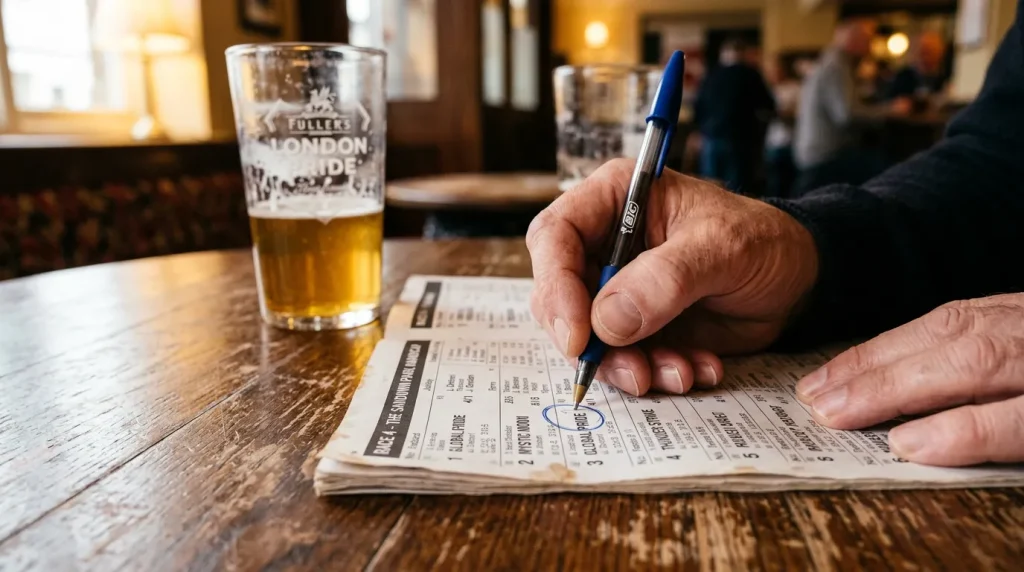
A NAP is the single selection a tipster is most confident about on any given day of racing. Not their second-best fancy, not a speculative punt at a big price — the NAP is the tipster’s strongest conviction, the one pick they would stake their reputation on if forced to choose just once. The term has become so embedded in British racing culture that every national newspaper publishes a daily NAP alongside its racing coverage, and entire league tables exist to track which tipsters’ NAPs perform best over a season.
The word itself has an unlikely origin — it comes from a card game, not a racecourse — but the principle transferred neatly. When a tipster gives a NAP, they are making their boldest call of the day.
According to Business Research Insights, win bets account for 36% of the entire horse racing betting market — the largest single segment. A NAP is almost always presented as a win bet, which places it squarely in the mainstream of how punters actually wager. That matters because it means NAP selections are designed for the most common bet type, not for exotic multiples or speculative each-way plays. They are meant to be actionable and straightforward.
But here is the part most casual followers miss: a NAP is not the same thing as tipping the favourite. Plenty of tipsters will NAP a horse at 5/1 or bigger if they believe the price underestimates its chance. Understanding that distinction — between confidence and short odds — is what separates blindly following NAPs from using them intelligently.
Where the Word NAP Comes From
The card game Napoleon — often shortened to “Nap” — is a trick-taking game whose earliest rules were published in England in 1875. Best played by three to five players, the key mechanic involves bidding on how many of the five tricks you believe you can win. The highest possible bid is “nap” — a declaration that you will win all five. It carried the biggest reward if you succeeded and the steepest penalty if you failed.
By the late Victorian era, racing journalists and bookmakers had adopted the word. When a newspaper tipster declared a horse their “nap,” the implication was clear: this is my all-five-tricks call, the one I am most willing to stake my name on. The language stuck, and by the mid-20th century no racing page in a British newspaper was complete without a clearly labelled NAP. Notably, the game itself may have been named after the deposed Napoleon III rather than Napoleon Bonaparte — an appropriate irony for a term that now carries stakes of a rather different kind.
What started as a quirky borrowing from card tables became a structural feature of racing media. The Naps Table — published daily in the Racing Post and several other outlets — ranks newspaper tipsters by the cumulative profit or loss of their NAP selections across an entire season. It turned a casual tradition into a competitive, measurable exercise. Tipsters know their NAP record will be scrutinised, which, in theory at least, keeps them honest.
How Tipsters Select Their NAP of the Day
There is no universal formula for selecting a NAP, but the process among serious tipsters follows a recognisable pattern. It starts with the day’s racecards — the full list of runners across every meeting. A tipster will study form, going conditions, jockey bookings and market prices before even considering which horse deserves the top billing. The NAP is not chosen first and justified afterwards; it emerges from a filtering process.
Form strength is the obvious starting point. A horse that has been running consistently well — finishing in the first three over its last few starts, ideally with improving figures — will catch the eye. But consistency alone is not enough. The tipster also needs to believe the horse is well placed in today’s specific race: the right trip, suitable ground, a fair draw and an opposition that looks beatable. A horse with outstanding form but a terrible draw in a sprint might be passed over in favour of something less flashy with a clearer path to the win.
Then comes price. The tipster’s strongest conviction does not have to be priced short. Some NAP specialists — the ones who top long-term Naps Tables — deliberately lean towards value selections, picking horses whose odds are bigger than their chances warrant. Others play it safer, NAP-ing well-fancied runners whose form profile makes defeat unlikely. The former approach produces bigger peaks and deeper troughs; the latter grinds out steadier, if less spectacular, returns.
Race selection matters too. Many experienced tipsters avoid NAP-ing in large-field handicaps, where the outcome is inherently unpredictable, and prefer conditions races, novice events or small-field contests where the variables are easier to assess. A six-runner novice hurdle at Exeter offers far more clarity than a twenty-runner handicap at Newbury, and clarity is what you want when putting your strongest call on the line.
Opposition quality rounds off the decision. Even if a horse’s own form is strong, the NAP should ideally face rivals whose credentials are a notch below. It is the combination — strong form, fair price, suitable conditions, vulnerable opposition — that produces a genuine NAP rather than a hopeful guess.
NAP, Next Best and the Daily Hierarchy
Below the NAP in every tipster’s daily column sits the Next Best — abbreviated to NB. If the NAP is the strongest conviction, the NB is the second-strongest: a selection the tipster rates highly but not quite at the same level of certainty. Some punters ignore the NB entirely, focusing only on the headline selection. Others treat the NAP and NB as a natural daily double, backing both as singles. There is no right answer, but knowing the hierarchy helps you calibrate how much weight to give each tip.
A few outlets extend the hierarchy further. You will sometimes see a tipster list a NAP, NB and a “longshot” or “outsider of the day.” The longshot is explicitly speculative — a horse at big odds that the tipster thinks has been overlooked. It carries none of the conviction of the NAP but offers a disproportionate return if it lands. Staking on these three tiers should obviously reflect the confidence level: heaviest on the NAP, lighter on the NB, pocket change on the outsider.
As Lord Grade of Yarmouth noted in written evidence to Parliament, “Horseracing is interlinked with the gambling sector, as one of the most recognisable and popular products on which people gamble.” That interconnection runs through the daily NAP ritual. Newspapers publish NAPs because their readers bet on them; bookmakers price NAPs into their market movement models; and the sport itself benefits from the engagement that a clearly framed daily tip generates. The NAP is not just a selection — it is a cultural bridge between racing coverage and betting activity.
How to Use NAP Selections in Your Betting
The simplest way to use NAP selections is to follow them blindly at level stakes — back every NAP from a chosen tipster with the same fixed amount and track the results over months. This is, in fact, exactly how the Naps Table works. It records the profit or loss of each tipster’s NAP at starting price, level stakes, across the entire season. If a tipster shows a level-stakes profit over hundreds of selections, their NAP methodology is producing an edge. If they do not, it is not.
But blind following has a drawback: it removes your own judgement from the equation entirely. A more nuanced approach treats the NAP as a starting point rather than a final answer. The tipster has flagged a horse as their strongest conviction — now you check whether you agree. Does the form stack up under your own reading? Are the ground conditions right? Has the price shortened since the NAP was published, or is there still value?
Data from On Course Profits shows that market favourites win roughly 34.4% of the time over a five-year sample using Betfair starting prices. A NAP is emphatically not the same thing as the market favourite — many NAPs are given to horses at 3/1, 5/1 or bigger. If a tipster’s NAPs had the same strike rate as the market favourite, roughly one in three, you would need their average winning odds to compensate for the losing two-thirds. That is the mathematical reality behind the daily headline.
The Naps Table itself is an underused tool. Rather than following a single tipster’s NAP each day, some punters track the table for a month and identify which tipsters are in strong form over recent weeks. Form among tipsters, like form among horses, tends to cluster. A tipster who has found four winners from their last ten NAPs may be reading conditions particularly well right now. That kind of meta-analysis — tipping the tipsters, if you like — adds a layer of selectivity that flat following cannot provide.
Finally, keep your expectations calibrated. No tipster, however skilled, produces a winning NAP every day. A long-term strike rate of 25–35% at profitable average odds is a strong record. The NAP is a tool — the tipster’s strongest conviction — not a guarantee. Treat it as one input among several, track it properly, and it becomes a genuinely useful part of your betting process.