
Horse Racing Accumulator Tips — How to Build Smarter Accas
Best Horse Racing Betting Sites – Bet on Horse Racing in 2026
Loading...
Horse racing accumulators promise enormous returns from tiny stakes. A £2 five-fold at decent odds can return hundreds, sometimes thousands of pounds — figures that bookmakers are only too happy to advertise with screenshots of winning slips on social media. The thrill is real — the odds are against you. And the gap between that thrill and the mathematical reality is wider than most casual punters appreciate.
An accumulator, or “acca,” links two or more selections into a single bet where every leg must win for the bet to pay out. The odds multiply with each addition, which is why the potential returns look so appealing. But probabilities multiply too, in the opposite direction. Each leg you add does not just increase your potential payout — it exponentially reduces your chance of collecting it.
Consider the baseline: data from On Course Profits, drawn from Betfair starting prices over five years, shows that market favourites win approximately 34.4% of the time. Even if every leg of your acca is a favourite — the most likely winner in each race — a four-fold favourite accumulator has roughly a 1.4% chance of landing. That is one winner in every seventy attempts. At bigger prices, the numbers get bleaker still.
None of this means accumulators should be avoided entirely. They have a place — a small, carefully managed place — in a betting strategy. But building them smartly requires understanding what you are actually betting against, and adjusting your approach accordingly.
How Accumulator Bets Work
The mechanics are simple. A double links two selections: if both win, the returns from the first are staked on the second. A treble adds a third leg. A four-fold adds a fourth. Five selections onward and you are into five-fold, six-fold and beyond — though anything above a five-fold is an exercise in optimism more than strategy.
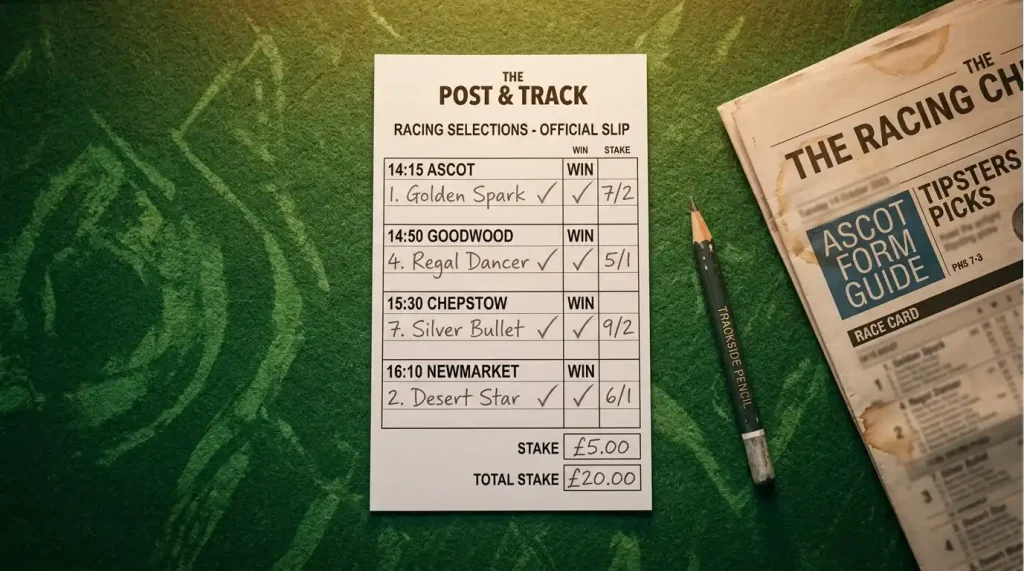
Suppose you back three horses in a treble at odds of 2/1, 3/1 and 5/1. If all three win, the combined odds are calculated by multiplying the decimal equivalents: 3.0 × 4.0 × 6.0 = 72.0. A £1 treble returns £72. The same three horses backed as separate singles at £1 each would cost £3 and return £2 + £3 + £5 = £10 profit (assuming all three win). The acca delivers a much bigger return from a smaller outlay — but only when every single leg lands.
If even one selection loses, the entire accumulator is dead. There is no partial payout, no consolation for getting three out of four right. This all-or-nothing structure is the fundamental tension of the acca: the reward scales dramatically, but the risk of total loss is disproportionately high. Bookmakers love accumulators for precisely this reason. The margin they build into each individual price compounds across legs, so the effective overround on a four-fold or five-fold is significantly higher than on any single bet.
The Probability Reality Check
The probability reality check for accumulators is sobering and essential. Multiplying individual probabilities reveals how quickly the odds stack against you.
Start with a double — the simplest accumulator. Two favourites, each with a 34% chance: 0.34 × 0.34 = 11.6%. That sounds manageable, roughly one in nine. Now add a third leg: 0.34 × 0.34 × 0.34 = 3.9%. Already one in twenty-five. A five-fold: 0.34 to the power of five = 0.45%. One in roughly two hundred and twenty attempts. A six-fold: 0.15%, or one in approximately six hundred and sixty. These are not exotic long shots — these are favourites, the horses the market considers most likely to win. Throw in a couple of 4/1 shots (20% implied probability) and the numbers collapse further.
The bookmaker’s overround makes matters worse. Each individual price in a race market is slightly shorter than the “true” probability warrants — that is how bookmakers make their profit. On a single bet, that overround might be 5–15%. But in an accumulator, the overround compounds. A 10% margin on each of four legs produces a cumulative margin significantly higher than 10%. You are paying the bookmaker’s edge not once but on every leg, and the effective tax on your acca rises with each selection added.
This is why professional bettors — the ones who manage their money systematically — almost universally avoid large accumulators. The guideline from Albion Research, drawing on the Kelly Criterion framework, suggests that serious bettors should not risk more than 2.5% of their bankroll on any single bet. For accumulators, the appropriate stake is even smaller, because the probability of winning is so low. A £1 or £2 acca as entertainment is harmless. A £50 five-fold as a serious betting strategy is not.
None of this means accumulators never win. They do — and when they do, the returns are memorable. But confusing memorable wins with sustainable strategy is a mistake the numbers do not support.
Building Smarter Accumulators
If you are going to build accumulators — and there is no shame in it, provided your stakes reflect the reality — certain approaches improve your chances, even if “improve” is a relative term in a format structurally tilted against you.
Fewer legs is the single most impactful adjustment. A double has a realistic chance of landing. A treble is plausible. Beyond three legs, the probabilities thin so quickly that you are essentially buying a lottery ticket. If your goal is excitement, fine. If your goal is to win more often than you lose, keep it to two or three selections.
Correlated selections offer another edge. Rather than picking horses from six unrelated races at different courses, consider building accumulators from a single meeting where your analysis of conditions — the going, the pace bias, the track configuration — applies consistently. If you believe soft ground at Haydock favours front-runners, selecting two or three front-running types from the same card creates a correlated accumulator where your thesis, if correct, helps every leg.
Backing to a target profit rather than chasing the biggest possible payout is a discipline that separates thoughtful acca builders from hopeful ones. Instead of asking “what are the biggest odds I can string together?”, ask “what return would I be happy with, and what is the shortest-odds combination that achieves it?” A double at 3/1 and 5/1 returns 23/1 — not a headline-grabbing payout, but far more likely to land than a five-fold at the same individual prices.
Finally, consider each-way accumulators on larger-field races. An each-way double or treble in big handicaps gives you more ways to collect: you can profit if your selections place without winning. The returns are smaller, but the frequency of payouts is significantly higher.
Acca Insurance and Boosts — What They Actually Offer
Most major UK bookmakers offer some form of accumulator insurance — typically a free bet refund if one leg of your acca lets you down. The headline pitch is attractive: “Get your stake back as a free bet if one selection loses.” The reality, as always, involves conditions.
First, the refund is usually a free bet, not cash. A free bet carries restrictions: it often cannot be withdrawn, only the profit from a winning free bet is paid out, and it may expire within a few days. The value of a free bet is therefore less than its face value — industry estimates put it at roughly 70% of the equivalent cash amount, depending on how you use it.
Second, insurance typically requires a minimum number of legs (usually four or five) and minimum odds per leg (often 1/5 or longer). These conditions push you towards exactly the type of high-leg, high-risk accumulators that the probability maths warns against. The insurance mitigates one failure mode — losing by a single leg — but does nothing for the far more common outcome of losing by two, three or more legs.
Accumulator boosts work differently. Some bookmakers add a percentage increase to your acca winnings: 5% for a double, 10% for a treble, and so on up. These can add up on longer accumulators, but they do not change the underlying probability of winning. A 10% boost on a payout you have a 1% chance of collecting is not a game-changer. Use these offers when they align with bets you would place anyway, but do not let them alter your selection process or stake size. The thrill is real — the odds are against you, with or without a marketing sweetener on top.