
Flat Racing vs National Hunt — Key Differences Every Bettor Should Know
 Available in US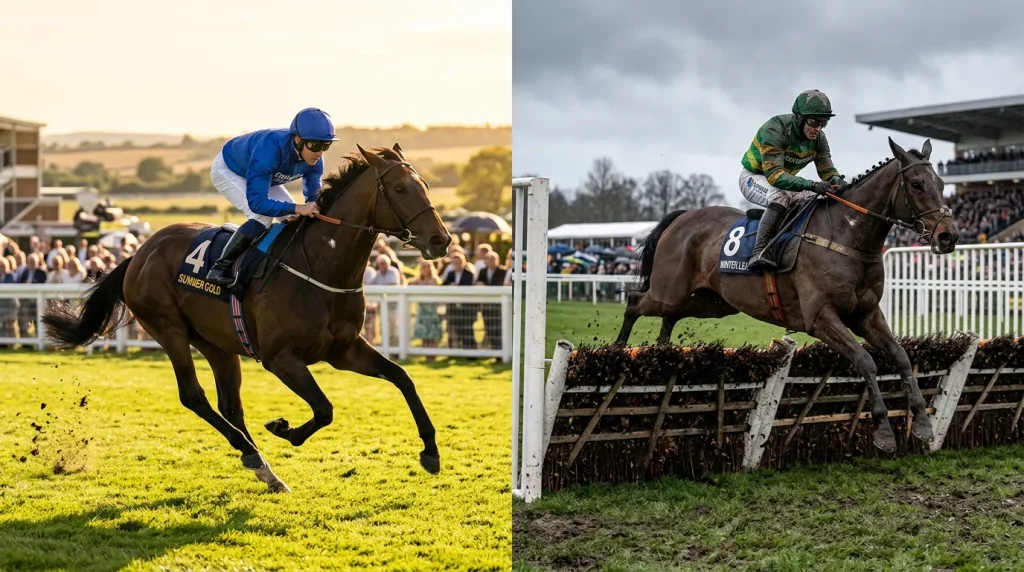
British horse racing runs on two codes — Flat and National Hunt — and while the fundamental activity is the same (horses racing against each other, punters betting on the outcome), almost everything else differs: the season, the distances, the obstacles, the age of the horses, the size of the fields and the character of the betting markets. Understanding these differences is not academic — it directly affects which strategies work, which bet types offer value and how reliably you can read the form.
According to the BHA’s 2026 Racing Report, average field sizes on the Flat were 8.90 in 2026, with Premier Flat fixtures averaging 11.02. National Hunt fields were smaller: 7.84 overall, with Premier Jumps at 9.41. Those numbers matter for bettors because field size determines how many each-way places are available, how competitive the markets are and how much variance you should expect in the results. Two codes, two betting styles — and the punter who adjusts their approach to match each code’s characteristics has a structural advantage over the one who treats all racing the same.
Flat Racing — Speed, Youth and the Draw
The Flat season runs primarily from April to October on turf, though all-weather racing at venues like Lingfield, Wolverhampton and Kempton continues year-round. Flat races have no obstacles — horses gallop on the level over distances ranging from five furlongs (about 1,000 metres) to two miles and six furlongs. The majority of Flat races are contested over distances between six furlongs and a mile and a half.
Flat horses tend to be younger than their National Hunt counterparts. Two-year-olds make their debut on the Flat and form a significant proportion of the summer racing programme. Three-year-olds contest the classic races — the Guineas, the Derby, the Oaks, the St Leger — which are among the most prestigious events in world racing. Older horses (four and above) compete in open events and handicaps but rarely dominate the top-level programme in the same way.
The draw — the starting stall position — is a factor unique to Flat racing. On straight courses and tight tracks, the stall number can confer a measurable advantage or disadvantage depending on the going, the pace of the race and the track configuration. Punters who ignore the draw on courses with known biases are effectively ignoring free information.
Speed is the defining characteristic of Flat form. Horses are assessed by speed figures, ratings and time comparisons. A fast horse on quick ground at Newmarket is a known quantity; the same horse on soft ground at Chester is a different proposition entirely. Flat form tends to be more reliable and predictable than Jumps form because the absence of obstacles removes a major source of randomness — no horse falls, no horse makes a jumping error that costs five lengths. The best horse tends to win more often on the Flat, which compresses the odds of top-rated runners and makes value harder to find among the market leaders.
National Hunt — Stamina, Jumping and Winter Drama
National Hunt racing — also called Jump racing — runs primarily from October to April, though summer jumping exists at selected courses. Races involve either hurdles (smaller, flexible obstacles jumped at speed) or steeplechase fences (larger, solid obstacles that demand precision and courage). Distances are longer than on the Flat: hurdle races typically range from two to three miles, chases from two to four-plus miles.
The horses are older. National Hunt careers usually begin at age four or five, peak between seven and ten, and can extend well beyond. This maturity brings greater consistency — a seasoned chaser with fifty career starts has a well-established form profile — but also greater physical wear. Injuries are more common, and the training population has been shrinking. According to the BHA’s 2026 Racing Report, the number of horses in training fell to 21,728, a decline of 2.3% from the previous year and a continuation of a multi-year downward trend. That contraction affects National Hunt racing more acutely, because Jump horses require longer to develop and are more susceptible to injury than their Flat counterparts.
Jumping adds a dimension of randomness that the Flat does not have. A horse can be travelling beautifully, cruising towards the lead, and then make a fatal error at the third-last fence. Falls, unseats and blunders can eliminate any horse at any stage of the race, regardless of ability. That randomness creates opportunities for each-way bettors — the best horse does not always win — but also makes form analysis inherently less reliable. You are not just assessing a horse’s speed and stamina; you are assessing its jumping technique, its temperament under pressure and its physical durability over demanding obstacles.
How Betting Differs Between Flat and Jumps
The practical betting differences between Flat and Jumps flow directly from the characteristics described above, and adjusting your approach to each code is one of the simplest improvements a punter can make.
Form predictability is higher on the Flat. With no obstacles, fewer variables and generally larger, more competitive fields, the form book is a more reliable guide. This means favourites win slightly more often on the Flat, and the market is more efficient — finding value requires sharper analysis and earlier engagement with the market. On the Jumps, form is disrupted more frequently by jumping errors, falls and the unpredictable impact of soft winter ground. That disruption creates wider-priced winners and better each-way returns, but it also means your own form analysis will be wrong more often.
Each-way value tends to be stronger in National Hunt racing, particularly in big-field handicap chases and hurdle races where the element of jumping randomness increases the chance of an outsider finishing in the places. Flat handicaps can also offer each-way value, especially in large-field sprints, but the absence of jumping means the form book is a more reliable predictor of which horses will fill the places.
Going conditions affect both codes but in different ways. On the Flat, the going primarily influences speed: firmer ground produces faster times, softer ground slows the pace. In National Hunt racing, the going also affects jumping: softer ground makes take-offs and landings more demanding, increasing the chance of errors. A horse that jumps fluently on good ground may struggle to maintain its technique on heavy ground, which means going is an even more important form filter for Jump races than for Flat ones.
Ante-post markets are larger and more active for National Hunt festivals (Cheltenham, Aintree) than for Flat festivals, partly because the Jump season builds towards clear target events over several months. Flat ante-post betting accelerates later in the season, typically after the Guineas trials in spring. If you enjoy ante-post wagering, the Jump calendar offers a longer, richer market to engage with.
Which Code Suits Your Betting Style?
Choosing between Flat and National Hunt — or, more realistically, choosing how to weight your attention between the two — comes down to what kind of betting you enjoy and what kind of analysis you are best at.
If you prefer data-driven analysis, speed figures, draw bias studies and form that tends to hold up reliably, the Flat will suit your temperament. The markets are efficient, which means edges are narrow, but the consistency of outcomes rewards thorough preparation. You will bet on more races with smaller individual edges, and your profit comes from volume and precision.
If you prefer narrative, drama and each-way opportunities at bigger prices, National Hunt racing is the natural home. The jumping element introduces enough randomness to create regular upsets, which means each-way value is more abundant and patient punters who stick with horses through a losing spell are often rewarded. The trade-off is less reliable form and more frequent losing runs.
Many experienced punters follow both codes and adjust their staking and bet types accordingly: tighter margins and win-only bets on the Flat, each-way and slightly more speculative stakes on the Jumps. The all-weather programme provides year-round Flat racing even during the core Jump season, so there is no part of the calendar where only one code is available. Ultimately, the best code for your betting is the one you are willing to study seriously — because knowledge, not preference, is what produces profit.
