
Best Horse Racing Apps UK — Features That Make a Real Difference
 Available in US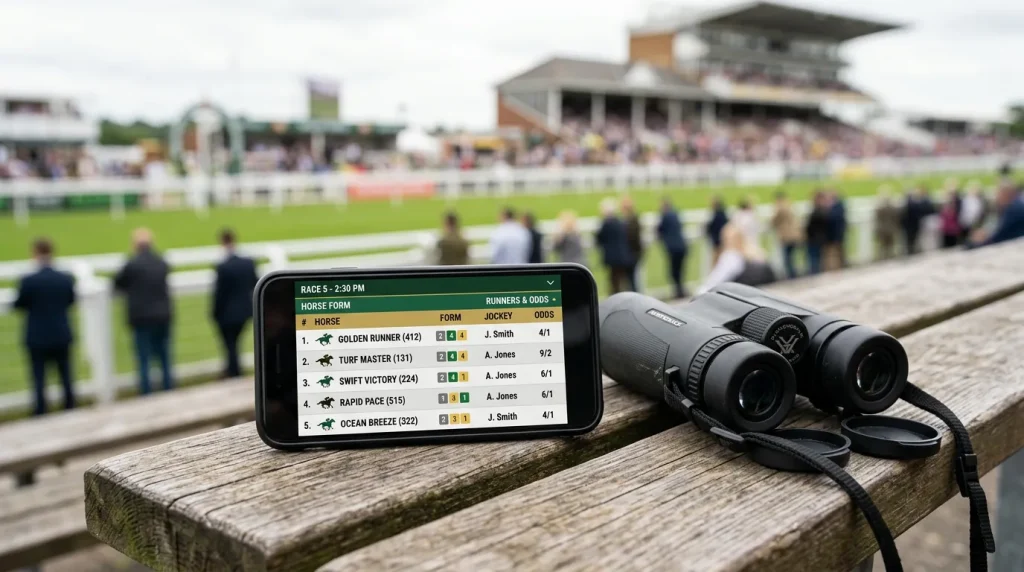
The smartphone has become your racecard in your pocket. According to the UK Gambling Commission, mobile devices account for more than 70% of all online gambling in the UK — a proportion that has climbed steadily every year and shows no sign of reversing. For horse racing punters, this shift means that the app you use to research, analyse and bet on racing is not a convenience; it is the primary interface between you and the sport.
But not all racing apps are built the same. The difference between a good app and a great one is not the colour of the logo or the size of the welcome bonus — it is whether the app gives you the information and tools you need to make better decisions, faster. Live streaming, form data, odds comparison, customisable alerts and clean navigation under race-day pressure are the features that matter. Marketing fluff, buried data and sluggish performance are the features that cost you money.
This guide examines what separates the best racing apps in the UK from the merely functional, without recommending specific brands. The right app depends on your betting style, your analytical depth and whether you primarily need a tool for placing bets, a tool for studying form, or — increasingly — both in a single package.
Features That Separate Good Racing Apps From Great Ones
Live streaming is the most impactful single feature a racing app can offer. Watching the race you have bet on — not just reading the result five minutes later — changes the experience fundamentally. It also provides genuine analytical value: you see how your horse runs, how it handles the ground, whether it was hampered or had a clear passage. That visual information feeds back into your future selections. Most major bookmaker apps offer live streaming to customers who have a funded account or have placed a bet on the race, and the quality of streams has improved dramatically in recent years.
Form data is the second pillar. At a minimum, a racing app should display full form figures for every runner: recent results, ratings, going preferences, course-and-distance records, trainer and jockey statistics. The best apps present this data in a format that is scannable on a mobile screen, with expandable sections rather than walls of numbers. If you find yourself squinting at a tiny table and scrolling endlessly to compare two horses, the app is failing at its core purpose.
Odds comparison — the ability to see prices from multiple bookmakers side by side — saves money on every bet. A horse priced at 5/1 with one bookmaker and 6/1 with another represents a 20% difference in potential profit. Apps that integrate odds comparison (Oddschecker is the best-known standalone option) let you identify the best available price in seconds. Some bookmaker apps also show “best odds guaranteed” badges, confirming that you will be paid at the bigger price if the starting price exceeds the odds you took.
Customisable alerts round out the essential features. The ability to receive a push notification when a specific horse, trainer or jockey is declared to run — or when a horse’s price moves significantly — means you do not need to monitor every racecard manually. Setting an alert for a trainer whose form you track closely, or for a horse you are waiting to bet on, turns your phone into a passive research assistant that flags opportunities as they arise.
Data-First Apps — Form, Ratings and Analysis
Not every racing app is attached to a bookmaker. A growing category of data-first apps prioritises analytical content — form, ratings, speed figures, trainer statistics — over the ability to place a bet. These apps are built for punters who want to do their homework on the move before opening a separate betting app to execute the wager.
The Racing Post app is the best-known example: it offers deep form data, expert analysis, Topspeed and RPR ratings, and racecards for every UK and Irish meeting. Timeform’s app provides its own proprietary ratings and position predictions. At The Races offers a Ratings Hub that combines speed and form figures in a single interface. None of these apps process bets directly, but all provide the analytical depth that bookmaker apps typically cannot match.
The value of data-first apps increases as field sizes grow and racing becomes more complex to decode. According to the BHA’s 2026 Racing Report, average Flat field sizes in 2026 were 8.90 runners, with Premier events averaging 11.02. In a typical field of nine or more horses, the amount of form data you need to process is substantial — trainer records, going preferences, course form, jockey statistics, recent ratings — and having it organised in a purpose-built analytical app is significantly faster than trying to extract the same information from a bookmaker’s racecard page.
Free tiers exist on most data apps, though the richest features — detailed speed figures, historical statistics, custom filtering — often sit behind a subscription. Whether the subscription is worth it depends on how seriously you approach your betting: for a casual once-a-week punter, the free tier is usually sufficient. For a daily bettor managing a structured bankroll, the analytical upgrade often pays for itself through better selection quality.
Betting Apps vs Information Apps — Do You Need Both?
The distinction between betting apps and information apps creates a practical question: should you use one app for everything, or separate your research from your wagering?
Bookmaker apps are optimised for speed of bet placement. The racecard is designed to get you from “browsing” to “bet confirmed” in the fewest possible taps. That efficiency is valuable when you are betting in the final minutes before a race — you do not want to fumble through screens when the price is moving. But the form data within a bookmaker app is typically shallower than what a dedicated data app provides: you get recent form, basic stats and odds, but rarely the depth of analysis, trainer breakdowns or speed figures that inform a thorough selection process.
Information apps, conversely, are optimised for analysis. They let you dig into form, compare ratings, study trainer records and build your own shortlist of contenders. But they do not let you act on that analysis directly — you need to switch to a bookmaker app to place the bet. That two-app workflow adds a step, but many experienced punters prefer it precisely because it separates the decision from the execution. You make your selection in a research environment, then execute it in a betting environment, rather than being nudged towards impulsive bets by a bookmaker interface designed to encourage wagering.
The ideal setup for most serious punters is both: a data app for research and a bookmaker app for execution. The data app is where you spend the most time — studying the card, filtering by going, checking trainer form. The bookmaker app is where you spend the least time — selecting the horse, entering the stake, confirming the bet. Keeping those functions separate helps maintain the discipline that profitable betting requires.
Matching an App to Your Betting Style
The right app depends on who you are as a punter — not on who the app’s marketing team thinks you should be.
If you bet casually — a few races on a Saturday, the occasional festival punt — a single bookmaker app with decent streaming and a clean racecard is all you need. Choose one that offers best odds guaranteed on UK and Irish racing, has reliable streaming, and lets you navigate quickly between meetings. The analytical depth of a dedicated data app is unlikely to change your results at this level of engagement.
If you bet regularly and treat it as a structured activity — tracking results, managing a bankroll, studying form daily — the two-app setup becomes worthwhile. A data app for research and a bookmaker app (or exchange app) for execution gives you the analytical tools to find value and the execution tools to capture it. Consider whether your primary focus is Flat or Jumps racing, since some data apps are stronger on one code than the other.
If you trade on exchanges — placing bets in-play, backing and laying for profit — your app requirements shift entirely towards speed, liquidity display and in-play interface quality. Exchange apps like Betfair and Smarkets are built for this purpose, and the difference in in-play usability between a good exchange app and a poor one can directly affect your profitability. Test the in-play interface with small stakes before committing to a platform, because latency and screen layout matter far more in live trading than in pre-race betting.
