
Horse Racing Draw Bias — How Stall Position Affects Results at UK Courses
 Available in US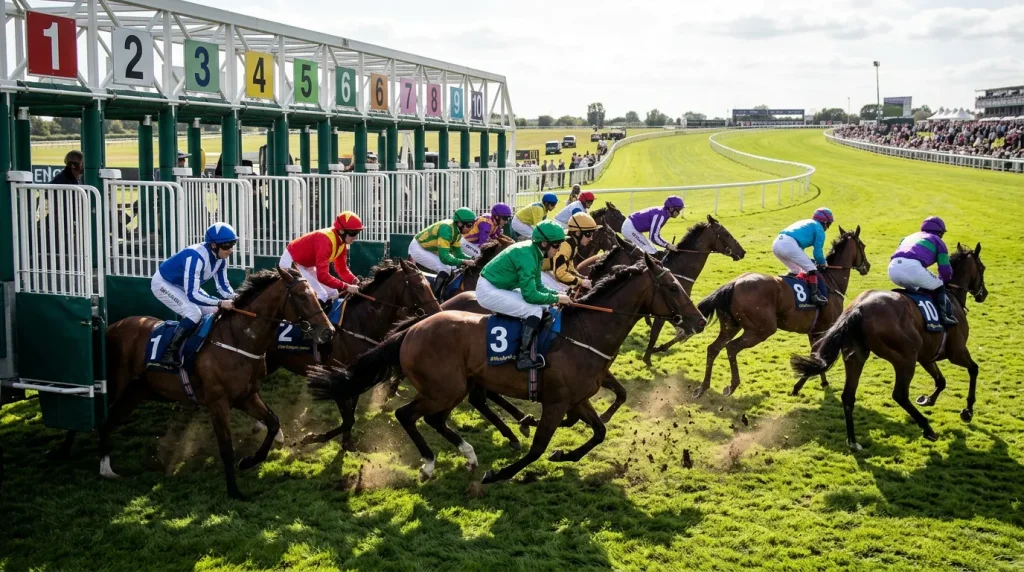
In horse racing, where you start can decide where you finish. The draw — the numbered stall from which each horse breaks at the start — is assigned randomly, and in theory every stall should offer an equal chance. In practice, the physical configuration of many UK racecourses creates measurable advantages for certain stall positions over others. A horse drawn on the wrong side of a biased course faces a handicap that no amount of form, fitness or jockey skill can fully overcome.
Draw bias is a Flat racing phenomenon. National Hunt races almost universally start from a tape or flag, where all runners line up abreast without stalls, so the concept does not apply. But for Flat races — especially sprints and mile races on straight courses — the draw is a genuine selection factor that many casual punters ignore entirely.
According to the BHA’s 2026 Racing Report, average Flat field sizes were 8.90 runners in 2026, rising to 11.02 for Premier fixtures. In larger fields, draw bias is amplified: more horses mean tighter bunching at the start, less room to manoeuvre into a preferred position, and a greater chance that a horse drawn on the disadvantaged side of the track will be unable to recover. Understanding draw bias transforms the racecard from a list of horses into a map of advantage and disadvantage.
What Draw Bias Means and How It Develops
Draw bias develops when the physical characteristics of a racecourse create an uneven playing field between different stall positions. Several factors contribute.
Track configuration is the most fundamental. Courses with sharp bends shortly after the start — Chester is the extreme example — favour inside draws because those horses travel a shorter distance around the turn. Horses drawn wide must cover additional ground or burn energy trying to cross to the inside early, both of which compromise their finishing effort.
Camber and gradient also play a role. Some courses slope towards one rail, encouraging runners to drift in that direction. If the slope favours the stands rail, horses drawn low (near the stands) have a natural advantage. If it favours the far rail, high draws benefit. The effect is subtle — a few degrees of camber — but over six furlongs at pace, a subtle lean translates into measurable ground lost or gained.
Ground conditions interact with track configuration to create draw biases that shift throughout a meeting. Watering patterns, traffic from previous races and natural drainage all affect where the best ground lies. On a dry day when the ground is faster near the stands rail, low draws benefit. After rain, the centre of the course may offer better footing, neutralising or reversing the dry-day bias. This variability is why draw bias cannot be reduced to a fixed rule for each course — it needs to be assessed on the day, accounting for the current conditions.
Wind direction, though rarely discussed, can also influence draw advantage on straight courses. A crosswind that pushes from one side of the track to the other gives a slight aerodynamic advantage to the group sheltering on the windward side, while the group on the leeward side fights both the wind and the horses around them.
UK Courses with Significant Draw Bias
Several UK courses have well-documented draw biases that persist across seasons, and knowing them is a practical advantage for any Flat punter.
Chester is the most extreme case. Its tight, circular layout — barely over a mile in circumference — means that races of seven furlongs and above involve running almost entirely on the bend. Low draws (stalls 1–4) have a significant statistical advantage because they sit closer to the inside rail and travel less ground. A horse drawn in stall 10 at Chester over seven furlongs faces a task that form alone often cannot overcome. The bias is so well known that the market partially prices it in, but not always fully — especially in larger fields where the bookmaker has more runners to price and the draw effect is diluted across the odds.
Beverley, a sharp right-handed track in Yorkshire, shows a consistent advantage for high draws over five furlongs, because the far-side rail offers firmer ground and a marginally shorter path. Carlisle’s undulating straight course favours different draws depending on going: low draws in dry conditions, less pronounced bias on softer ground. Musselburgh’s tight right-handed layout produces advantages for low draws similar to Chester’s, though less extreme.
Even unique tracks have their patterns. Data from OLBG course statistics shows that Newton Abbot — a National Hunt course, so draw is irrelevant there — has a 51.38% favourite win rate, the highest in the country. The point is that individual course characteristics always matter: every track has its own personality, and the punter who studies those personalities has an edge over the one who treats all courses as interchangeable.
Ascot’s straight course presents one of the most debated draw biases in top-level Flat racing. Over five and six furlongs, the bias shifts with the going and the field size. In big-field sprints on quick ground, higher-numbered stalls (drawn towards the far side) tend to produce more winners. On softer ground the effect weakens or reverses. Because Ascot hosts Royal Ascot — the most prestigious Flat meeting of the year — understanding its draw patterns has outsized financial importance.
How Distance and Going Modify Draw Effects
Draw bias is not a fixed property of a racecourse — it varies by distance, by going and sometimes by the time of year.
Distance is the clearest modifier. Sprint races (five to six furlongs) are the most draw-sensitive because the horses cover less ground and have less time to adjust their position after the start. A horse drawn badly in a five-furlong dash at Chester has virtually no opportunity to recover — the race is over in sixty seconds. Over longer distances (a mile and beyond), the draw effect diminishes because horses have time to settle into positions and find the best ground regardless of where they started. By the time a race reaches a mile and a half on a round course, the draw is almost entirely irrelevant.
Going conditions modulate the bias within each distance. On fast ground, the strip closest to the stands rail (or whichever side is driest) offers the firmest, fastest surface. Horses drawn on that side gain a speed advantage. On softer ground, the surface is more uniform — the difference between one strip and another shrinks — and the draw bias correspondingly weakens. After sustained rain, the best ground may move to the centre of the track where drainage is better, potentially reversing the dry-weather pattern.
Seasonal patterns tie into going. Early-season meetings on fast ground produce the strongest draw biases. Mid-summer meetings, if watered consistently, may neutralise biases that existed in the spring. Autumn meetings on rain-softened ground tend to show reduced draw effects. Tracking how the draw has played out on earlier days of a multi-day meeting — as you can at festivals like Royal Ascot or the Ebor meeting at York — gives you real-time intelligence about which stall positions are favoured on the current ground.
Incorporating Draw Bias Into Your Selections
Incorporating draw bias into your selections adds a layer of analysis that most casual punters skip — which is exactly why it has value. If the form points to two horses with similar claims and one has a favourable draw while the other does not, the draw can be the tiebreaker.
Free draw data is available from several sources. OLBG publishes course-by-course draw statistics. The Racing Post includes draw analysis in its racecard notes for courses with known biases. At The Races and Timeform also flag draw concerns in their previews. The data typically shows win percentages by stall group (low, middle, high) for each distance at each course, which is enough to identify whether a meaningful bias exists.
The key is to use draw data as a filter, not a selection method. A horse with excellent form and a poor draw is not automatically eliminated — it may still be good enough to overcome the disadvantage. But a horse with moderate form and a poor draw on a high-bias course is in trouble. Conversely, a horse with moderate form and a perfect draw on a strongly biased course may be undervalued by a market that has focused on form alone. That is where the edge lives: in the gap between the market’s assessment of a horse’s chance and the additional information that the draw provides. The punter who accounts for stall position has an advantage before a stride has been taken.
